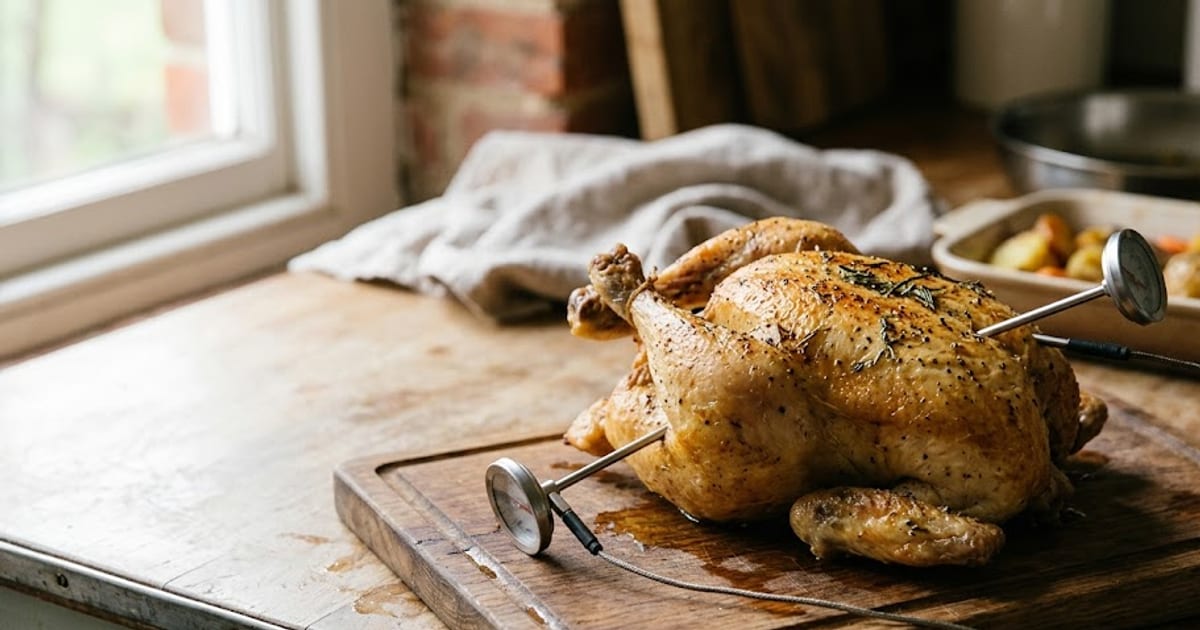
165°F is the safe minimum for every part of a chicken. It is also the right serving temperature for breast and the wrong one for thigh.
| Cut | Safe | Pull at | Best served |
|---|---|---|---|
| Breast, boneless | 165°F | 160°F | 165°F |
| Breast, bone-in | 165°F | 160°F | 165°F |
| Thigh, bone-in | 165°F | 180°F | 180–185°F |
| Drumstick | 165°F | 180°F | 180–185°F |
| Wings | 165°F | 175°F | 175–180°F |
| Whole bird, breast | 165°F | 160°F | 165°F |
| Whole bird, thigh | 165°F | 175°F | 175–180°F |
| Ground chicken | 165°F | 165°F | 165°F |
Why dark meat wants more
Thigh and drumstick are working muscle, laced with collagen and connective tissue. Collagen does not convert to gelatin in any useful quantity until around 170°F, and the conversion takes time as well as temperature.
A thigh pulled at exactly 165°F is safe and noticeably chewy — springy, slightly rubbery, tissue still intact. Held at 175 to 185°F for a few minutes it goes tender and moist, and the higher fat content in dark meat protects it across that range.
Breast has none of that fat. Past 165°F it dries fast, and past 175°F it is stringy.
That is the whole problem with roasting a chicken whole: the two parts want different temperatures and they are attached to each other.
What 165°F actually means
The figure is not a magic threshold. It is the temperature at which salmonella is killed instantly, which makes it convenient to print on a chart.
Pasteurisation is a function of temperature and time. Chicken held at 150°F for three minutes reaches the same log reduction as chicken that touches 165°F for an instant. That is the basis of sous-vide poultry, and it is why a breast rested after coming out at 160°F is safe by the time it is served.
It is not a licence to serve undercooked chicken. It is the reason the pull temperature can sit below the number on the chart.
Where to put the probe
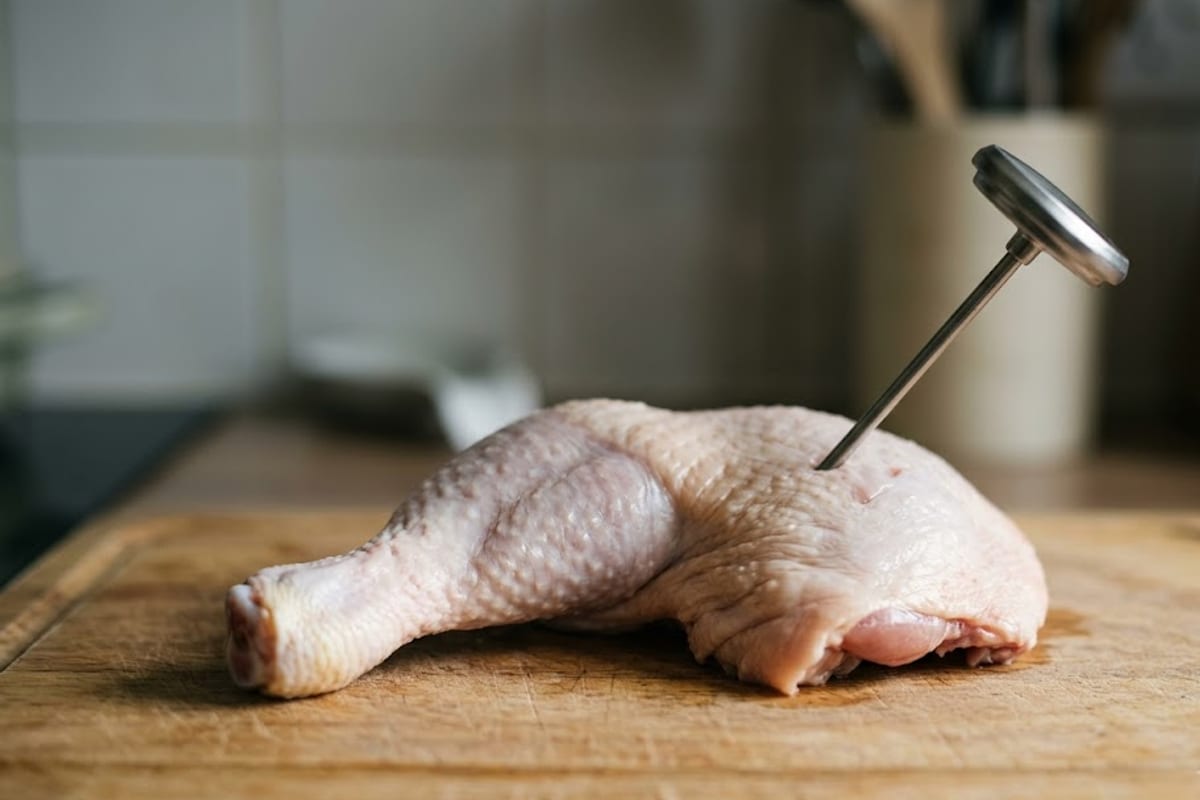
Breast: from the side, horizontally, into the thickest part. Top-down on a breast puts the tip too close to the pan.
Thigh and drumstick: into the thickest part, away from the bone. Bone conducts heat faster than meat and reads several degrees high — often ten — and that reading is exactly what sends an undercooked thigh to the table.
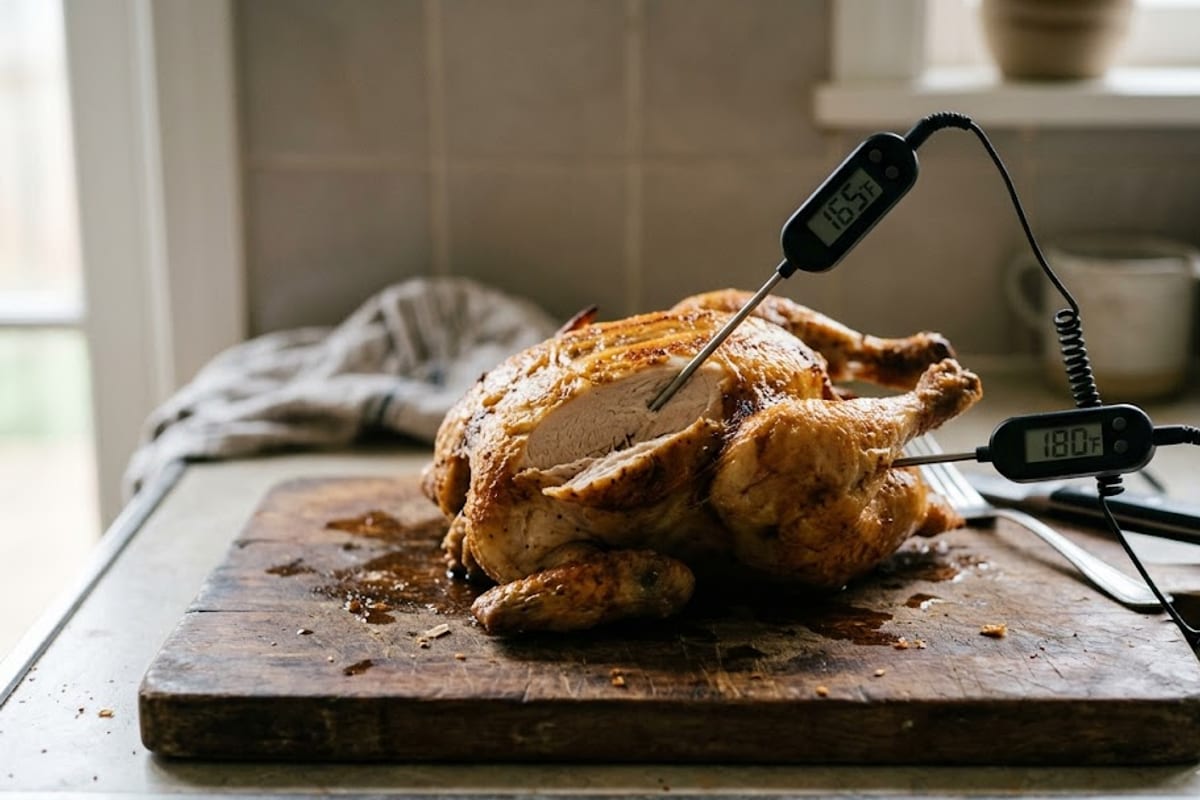
Whole bird: two readings. The inner thigh, away from the bone, and the thickest part of the breast. The bird is done when the thigh reads 175 and the breast has not passed 165, which is why the breast is worth protecting for the first half of the roast.
Stuffing changes the whole calculation
Stuffing inside a bird has to reach 165°F itself, and it sits in the coldest part of the cavity with meat insulating it on every side.
That is a genuinely difficult target. By the time stuffing at the centre of a chicken reaches 165, the breast around it is commonly at 180 and past saving. Cooking the stuffing separately in a dish and spooning it in afterwards solves the problem completely, and it is the reason most modern recipes stopped stuffing birds.
If it goes in the cavity, pack it loosely, take a separate reading in the middle of it, and expect the bird to take 30 to 45 minutes longer than an unstuffed one of the same weight.
Rested, not resting
Poultry needs less resting than red meat — 5 to 10 minutes for pieces, 20 for a whole bird. The purpose is not to redistribute juices so much as to let carryover finish the job while the surface stops steaming.
Longer than that and a bird cools past serving temperature, which no amount of gravy repairs.
What colour tells you: nothing
Chicken cooked to 165°F can stay pink near the bone, particularly in young birds — a reaction between bone marrow pigment and the meat, not undercooking. Chicken can equally be white throughout at 175°F and dry.
The probe is the only reliable test, and pull temperature and serving temperature are two different numbers for every cut on this page.
Times for each cut follow from these targets — see baking chicken breast and air fryer thighs.