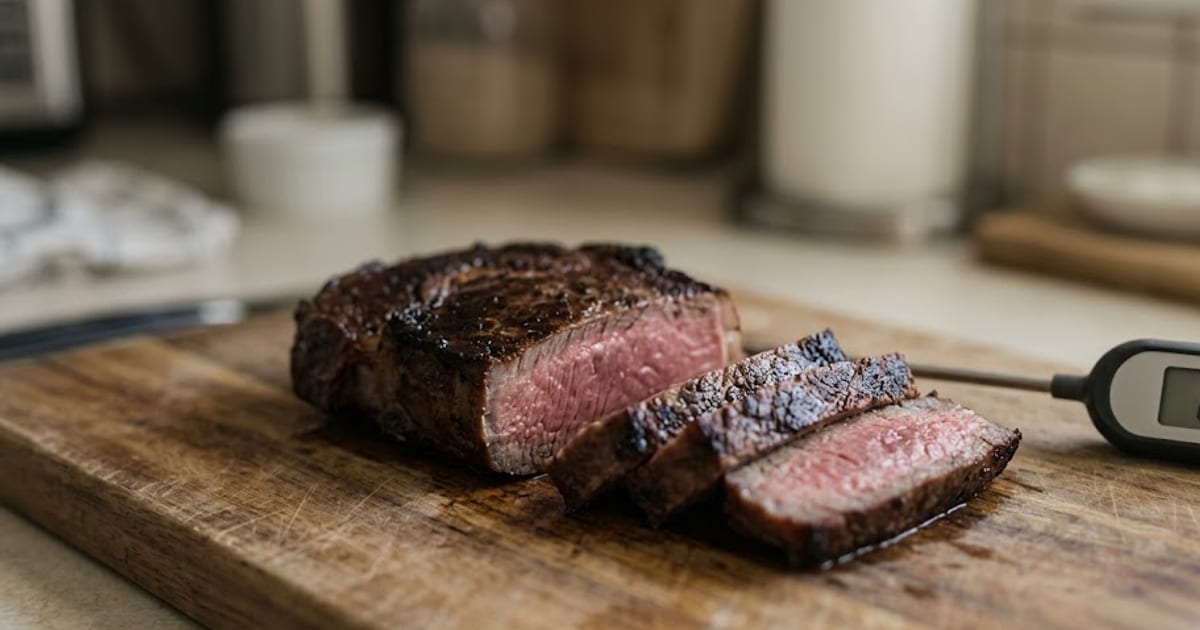
Medium rare steak serves at 130 to 135°F. Pull it off the heat at 125°F.
That five to ten degree gap is carryover cooking, and it is the single most common reason a steak cooked carefully to a chart arrives at the table medium.
The table both temperatures belong in
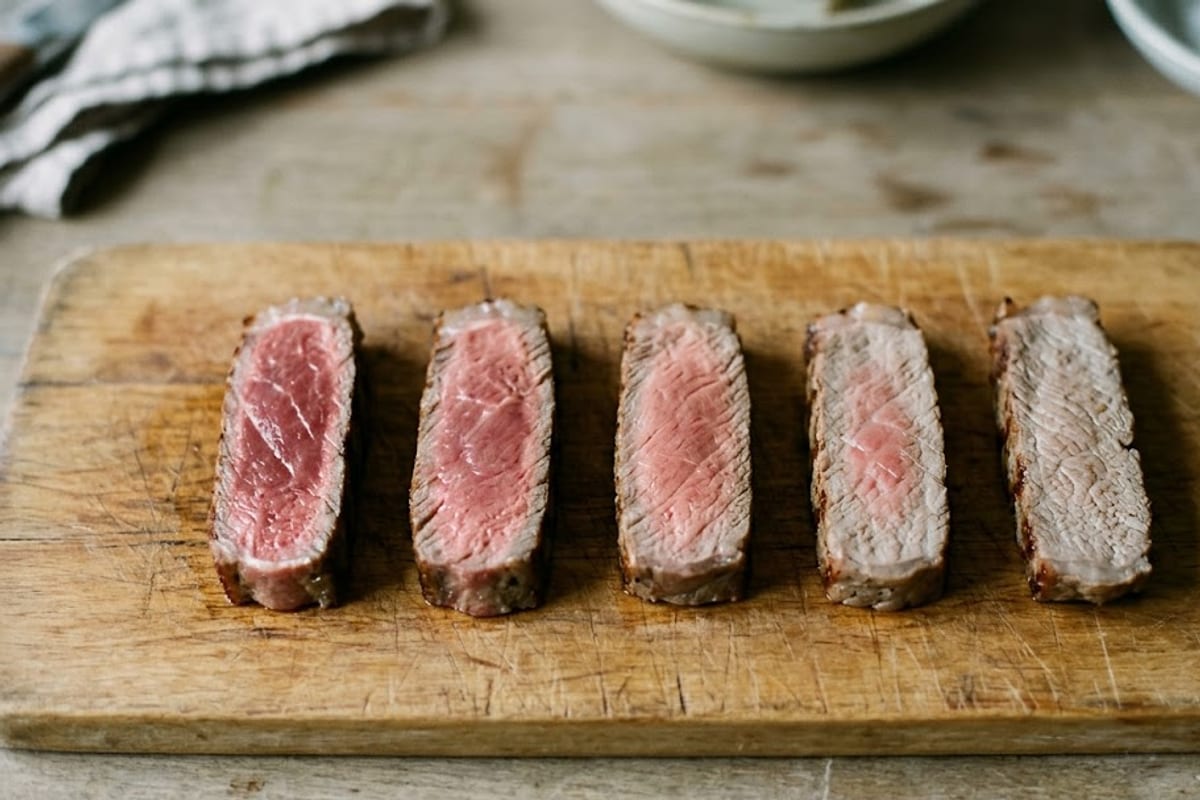
| Doneness | Pull at | Serves at | Centre |
|---|---|---|---|
| Rare | 115–120°F | 120–125°F | Cool red |
| Medium rare | 120–125°F | 130–135°F | Warm red |
| Medium | 130–135°F | 135–145°F | Warm pink |
| Medium well | 140–145°F | 145–155°F | Faint pink |
| Well done | 150°F+ | 155°F+ | No pink |
Most published charts show only the right-hand column. Cook to those numbers and you land one stage further along than you meant to.
How much carryover, exactly
Carryover is heat already inside the steak continuing to move toward the cooler centre after the heat source is gone. Its size depends on thickness and surface temperature, not on weight.
| Thickness | Method | Carryover |
|---|---|---|
| ¾ in | Pan sear | 2–3°F |
| 1 in | Pan sear | 3–5°F |
| 1.5 in | Pan sear, high heat | 5–8°F |
| 2 in | Reverse sear | 3–5°F |
| 2 in | Hot grill | 8–10°F |
| 3 lb roast | 350°F oven | 5–10°F |
Two steaks of the same weight carry over differently if one is thick and one is thin. And the same steak carries over less from a low oven than from a screaming pan, because the reverse-sear method never builds the steep outside-to-inside gradient that drives it.
Rest on a rack, not a plate, and not under foil. Foil traps steam, softens the crust you just built, and adds a degree or two you did not plan for.
Where the USDA number sits
The USDA safe minimum for whole cuts of beef is 145°F with a 3-minute rest — which is medium well.
Both things are true at once, and it is worth being straight about it: whole-muscle steak carries its bacterial risk on the surface, and a proper sear takes the surface far past any lethal threshold. That is the reasoning behind the near-universal practice of serving steak medium rare, and it is why the same reasoning does not transfer to ground beef.
| Cut | USDA minimum |
|---|---|
| Steaks, chops, roasts (beef, pork, lamb, veal) | 145°F + 3 min rest |
| Ground beef, pork, lamb, veal | 160°F |
| All poultry, including ground | 165°F |
| Fish and shellfish | 145°F |
| Egg dishes | 160°F |
Grinding moves surface bacteria into the middle, where no sear reaches. 160°F for burgers is not a conservative suggestion; it is a different problem to steak.
Anyone cooking for a young child, an older adult, a pregnant person or anyone immunocompromised should use the USDA column and not the culinary one.
Reading the probe correctly
Into the side, horizontally, to the centre. A steak an inch thick has no room for a probe pushed in from the top — the tip sits closer to the pan than to the middle, and reads high.
Away from bone and fat. Bone runs hotter, fat runs cooler. Either will move the reading several degrees.
Give an instant-read 2 to 3 seconds and watch for the number to settle. Cheap thermometers with thick probes take longer and cool the spot they are measuring.
Check the coldest steak, not the nearest one. In a pan of three, the one furthest from the burner centre governs when everything comes off.
Poultry inverts all of this, since thigh wants 175 to 185°F rather than the 165 on the safety chart, and roasts scale the carryover up, which is where oven timing starts.