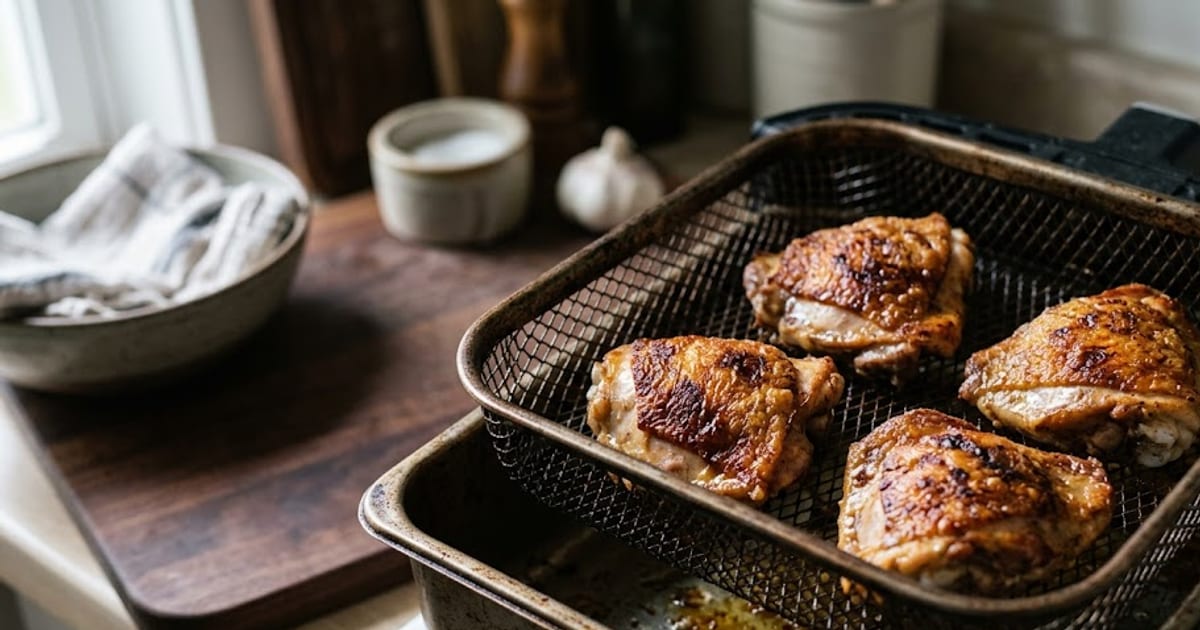
Bone-in, skin-on chicken thighs: 22 to 28 minutes at 400°F, skin side down for the first half. Boneless, skinless: 18 to 22 minutes at 380°F. Both flipped once.
Those numbers assume a single layer with air gaps. Crowd the basket and every figure below stops applying, for reasons covered further down.
The table
| Cut | Temp | Time | Flip at | Pull at |
|---|---|---|---|---|
| Bone-in, skin-on | 400°F | 22–28 min | 14 min | 175–185°F |
| Boneless, skinless | 380°F | 18–22 min | 10 min | 175°F |
| Bone-in, from frozen | 360°F then 400°F | 30–38 min | 20 min | 175–185°F |
| Thigh chunks, 1.5 in | 400°F | 12–15 min | 8 min | 175°F |
| Whole leg quarter | 380°F | 30–35 min | 18 min | 175–185°F |
Skin side down first is not a stylistic preference. The basket floor is the hottest surface in the machine; starting skin-down renders fat early, and the final upward-facing minutes crisp it without burning.
Why 175°F, when safe is 165°F
The USDA safe minimum for all poultry is 165°F, and a thigh hits it long before it is good to eat.
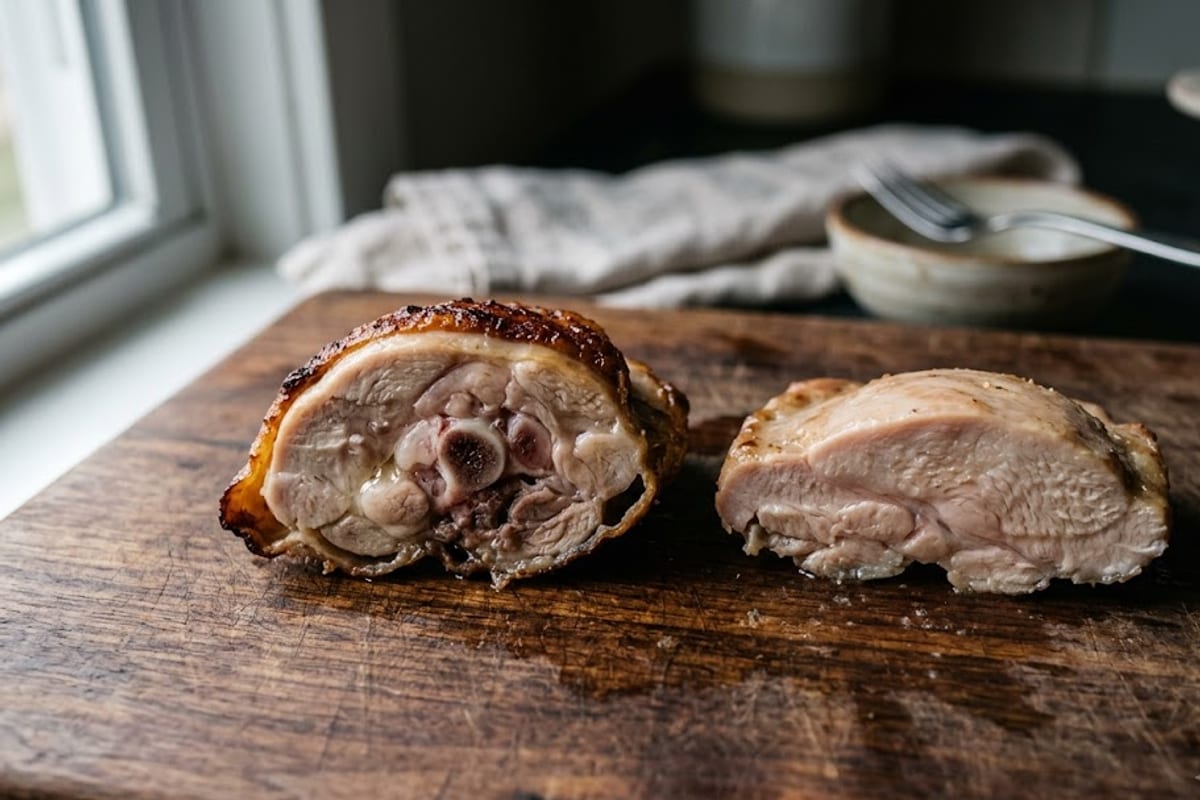
Thigh is working muscle, laced with collagen and connective tissue. Collagen does not begin converting to gelatin in any useful quantity until around 170°F, and the conversion runs on time as well as temperature. A thigh pulled at exactly 165°F is safe and noticeably chewy — springy, slightly rubbery, with the tissue still intact.
Held at 175 to 185°F for a few minutes, the same thigh goes tender and moist. The extra fat in thigh meat protects it from drying out over that range, which is precisely what a breast cannot do.
This is the clearest case in home cooking of safe and done being two different numbers, and it runs the opposite way to steak, where the safe number is well past the good one.
Breast is the reverse again: pull at 160°F and let carryover finish it, because past 165°F it dries fast.
Basket load changes everything
An air fryer is a small convection oven. It cooks by moving hot air across surfaces, so its speed depends entirely on air reaching every surface.
| Load | Effect |
|---|---|
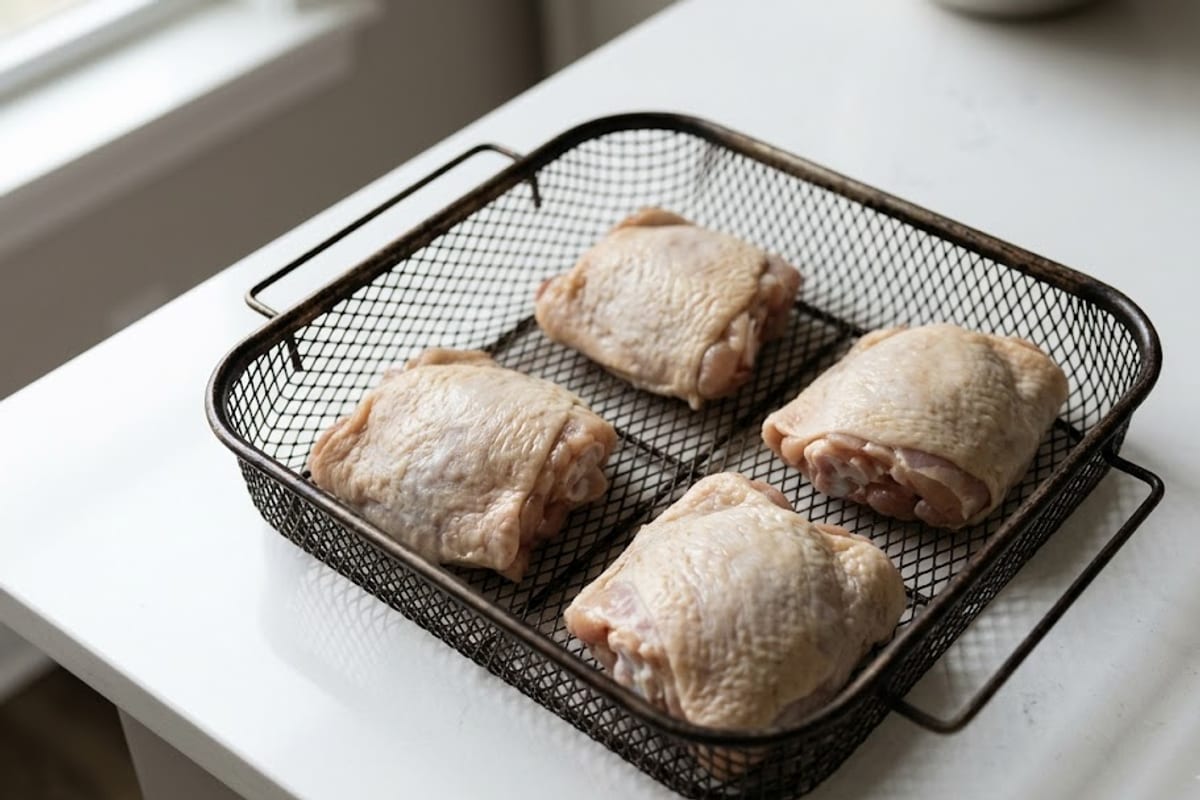
| Single layer, gaps between pieces | Times above apply |
| Single layer, pieces touching | Add 3–5 min; contact points stay pale |
| Stacked or overlapping | Add 8–12 min, flip twice, skin will not crisp |
| Half a basket | Subtract 2–3 min; check early |
Doubling the quantity in a basket does not double the time — it breaks the mechanism. Two batches of four thighs finish sooner, and better, than one crowded batch of eight.
Machine to machine, the spread is wide
Air fryer temperature dials are less accurate than oven dials, and there is no standard basket geometry. Two 5-quart machines at 400°F can differ by 25°F at the food surface, and a drawer-style basket cooks differently from a rack-style oven model.
Three consequences worth planning around:
No preheat is not the same as preheat. A cold start adds 3 to 4 minutes. Some manuals tell you to skip preheating; the times here assume 3 minutes of it.
Your first batch is calibration. Probe at the low end of the range the first time you cook thighs in a new machine, note the reading, and you will not need to guess again.
Smoke means fat on the drawer floor, not a fault. Bone-in thighs render a lot. A tablespoon of water under the basket stops the smoke without touching the cooking.
Probe placement
Into the thickest part, away from the bone. Bone conducts heat faster than meat, so a probe touching it reads high — often by 10°F — and that reading is what sends an undercooked thigh to the table.
For boneless thighs, go in from the side through the thickest edge rather than down from the top; they are rarely thick enough for a top-down probe to sit in the centre.
The same instrument, the same placement rule, and the same carryover arithmetic as the oven — carryover is just smaller here, 2 to 4°F, because the pieces are small.