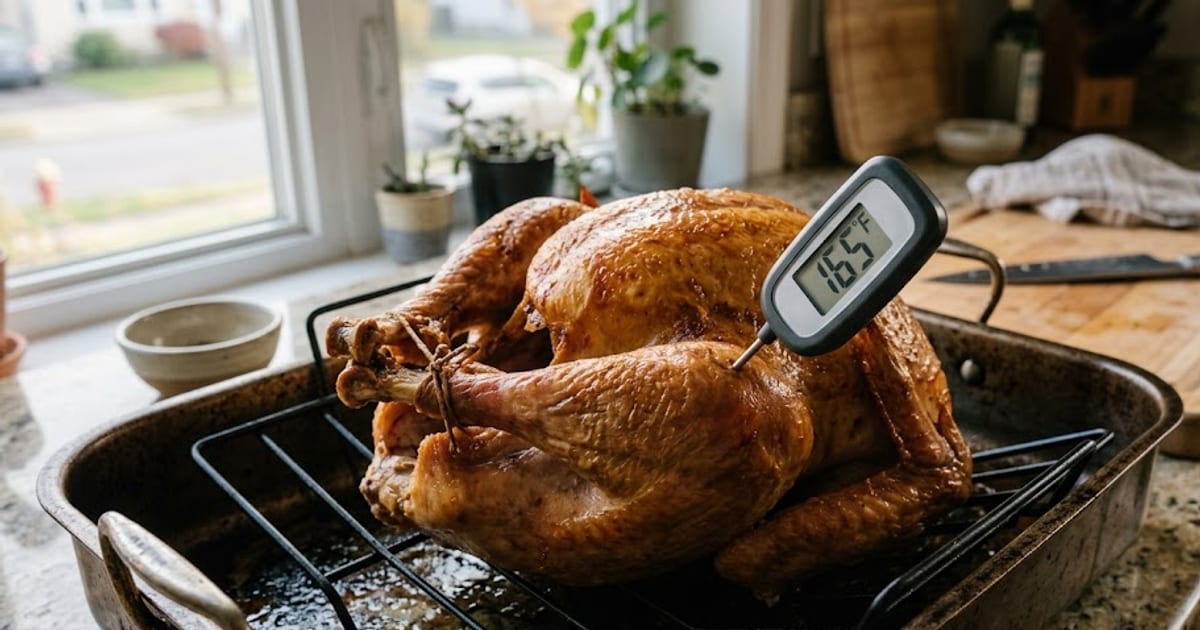
A turkey is safe to eat when the innermost part of the thigh, the innermost part of the wing and the thickest part of the breast have all reached 165°F. That is the USDA safe minimum for all poultry, and those are the three places FSIS tells you to check (FSIS, Let's Talk Turkey). If the turkey is stuffed, the centre of the stuffing must also reach 165°F.
Where to measure
| Spot | What you are checking | Target |
|---|---|---|
| Innermost thigh, near the body | Usually the slowest part | 165°F (175–180°F is better for texture) |
| Innermost wing | Joint area, easy to miss | 165°F |
| Thickest part of the breast | Close to the bone, not touching it | 165°F |
| Centre of the stuffing, if stuffed | Cavity heats slowest of all | 165°F |
FSIS recommends putting an oven-proof thermometer in the thickest part of the inner thigh at the start of cooking. When the thigh reaches 165°F, check the wing and the thickest part of the breast to make sure the whole bird has reached it.
Keep the probe off the bone. Bone runs hotter than the meat around it and gives a false high reading. Check in two places on each side if the bird is large.
Breast and thigh finish at different times
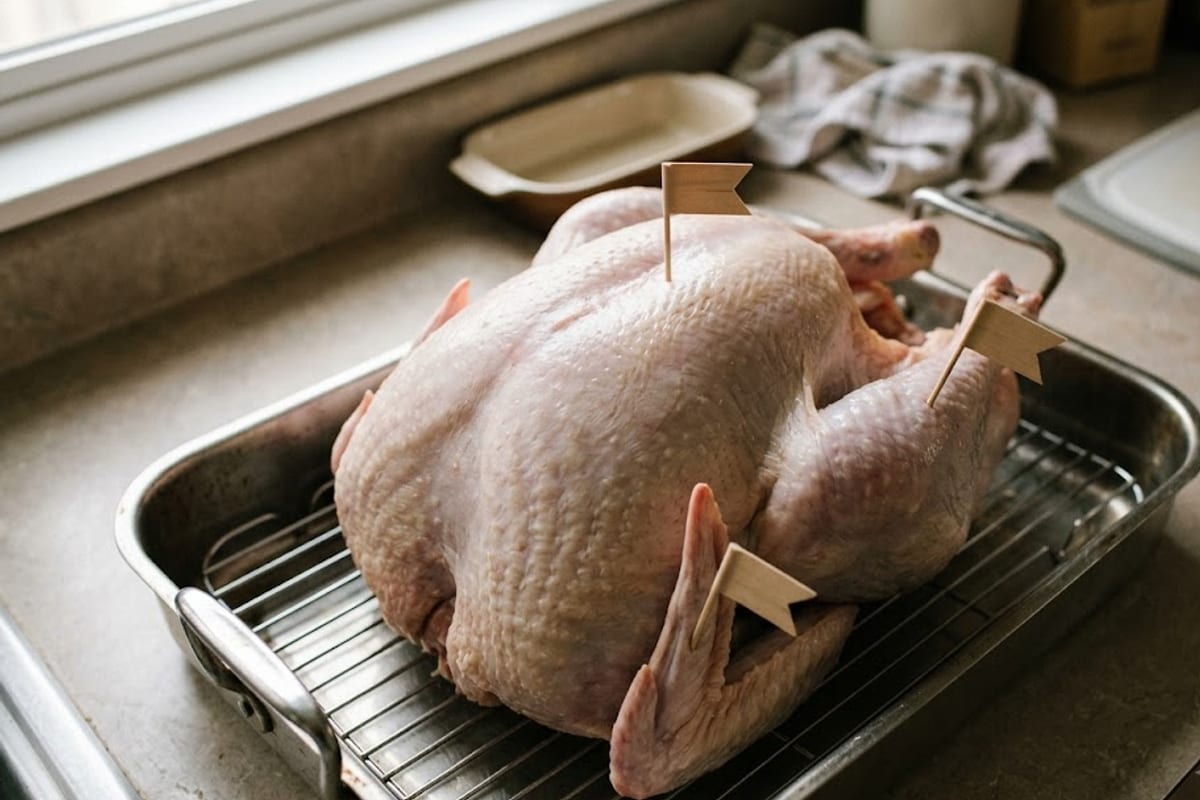
A turkey is two different kinds of meat on one frame. The breast is lean white meat that is juiciest at around 160 to 165°F and turns dry past about 170°F. The thighs and legs are dark meat with more connective tissue and fat. They are safe at 165°F but more tender at 175 to 180°F.
In a conventional roast, the breast sits on top, closer to the heat, and usually gets to temperature first. By the time the inner thigh reaches 175°F, the breast may be at 170°F or more. This is the reason so many roast turkeys have dry breast meat.
Ways to even it out:
- Spatchcock the bird. Removing the backbone and flattening it puts the thighs on the same level as the breast and cuts the roasting time roughly in half.
- Shield the breast. Cover the breast with foil for part of the roast, while the legs keep cooking. FSIS mentions using foil to prevent overbrowning once the bird is coloured.
- Cook the parts separately. Roast the breast and legs as separate pieces and take each out at its own temperature.
- Ice the breast. Some cooks chill the breast with ice packs before roasting so it starts cooler than the legs.
Carryover and when to pull
A large turkey keeps getting hotter after it leaves the oven. Heat stored in the outer layers moves inward, and the breast can rise 10 to 15°F while the bird rests. FSIS recommends letting the turkey stand for 20 minutes before carving.
Because of that rise, some cooks take the turkey out when the breast reads about 160°F and let carryover take it past 165°F. The timing page for whole turkey at 325°F uses that approach for a 14 lb bird, pulling the breast at 160°F and expecting it to reach about 175°F after resting.
The USDA guidance is to check that the bird has reached 165°F in all three spots. If you pull early, check again after the rest before carving. If you are cooking for anyone at higher risk from foodborne illness, leave the turkey in the oven until all three spots read 165°F.
USDA roasting times at 325°F
FSIS publishes these approximate times for a thawed turkey roasted at 325°F. FSIS advises setting the oven no lower than 325°F.
| Weight | Unstuffed | Stuffed |
|---|---|---|
| 4–8 lb (breast) | 1½–3¼ hours | Not usually applicable |
| 8–12 lb | 2¾–3 hours | 3–3½ hours |
| 12–14 lb | 3–3¾ hours | 3½–4 hours |
| 14–18 lb | 3¾–4¼ hours | 4–4¼ hours |
| 18–20 lb | 4¼–4½ hours | 4¼–4¾ hours |
| 20–24 lb | 4½–5 hours | 4¾–5¼ hours |
A turkey cooked from frozen takes at least 50 percent longer, according to FSIS. Times are only a guide for planning. The thermometer decides when the turkey is done. For other oven settings and a per-pound estimate, see how long to cook a turkey per pound.
Stuffing
FSIS does not recommend stuffing a turkey. The stuffing in the cavity is the last part of the bird to heat, and it has absorbed raw poultry juices. When it finally reaches 165°F, the breast is often well past done.
If you do stuff the bird, mix the stuffing just before filling, fill the cavity loosely, cook it immediately, and check that the centre of the stuffing reaches 165°F. Cooking the stuffing separately in a dish avoids the problem.
Pop-up timers
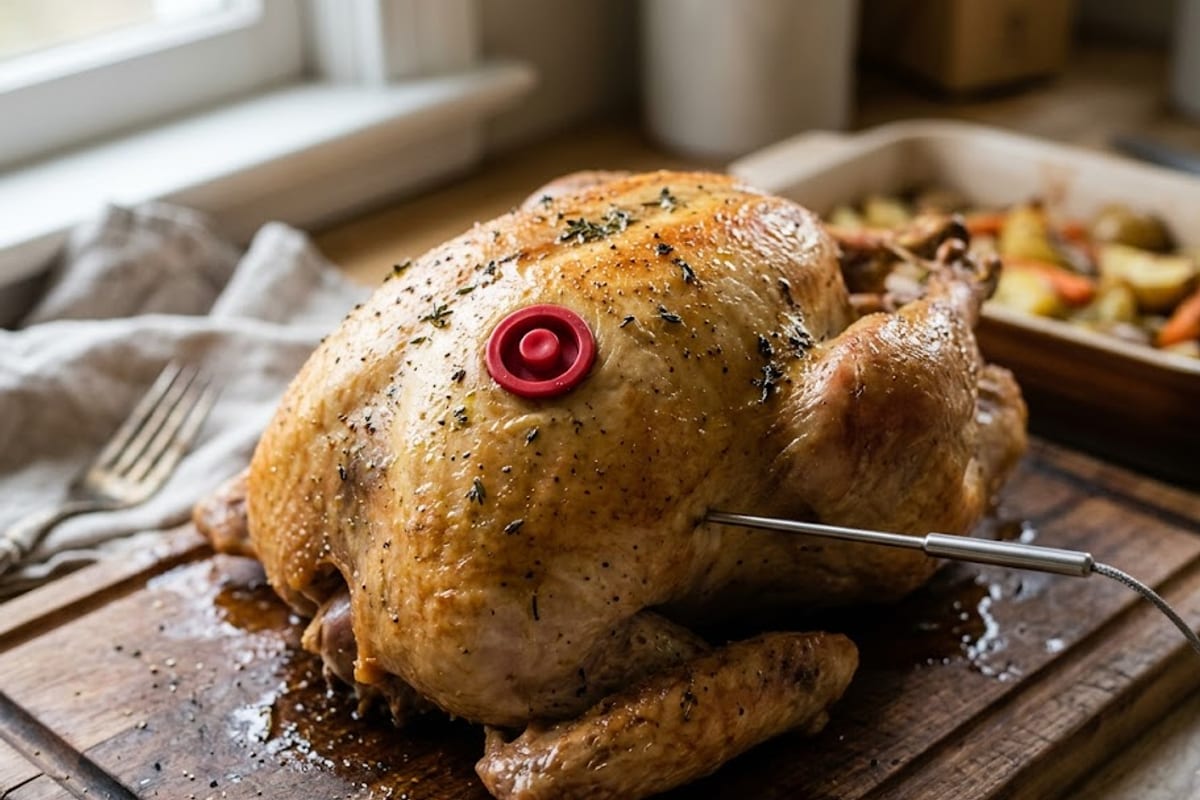
Many turkeys come with a pop-up timer in the breast. FSIS recommends checking the temperature in the thigh, wing and breast with a food thermometer as well, even when the timer has popped. The timers are set to pop at a temperature, but they sit in one spot of the breast and say nothing about the thigh or the stuffing.
Pink turkey
Turkey can stay pink after reaching 165°F, especially when it has been smoked or grilled, which can leave a pink ring about half an inch deep. FSIS explains that young birds, oven gases and naturally occurring nitrites can all give fully cooked turkey a pink tinge, and that commercially smoked turkey is always pink (FSIS, Is Pink Turkey Meat Safe?). The thermometer reading, not the colour, tells you whether it is safe.
Resting and carving
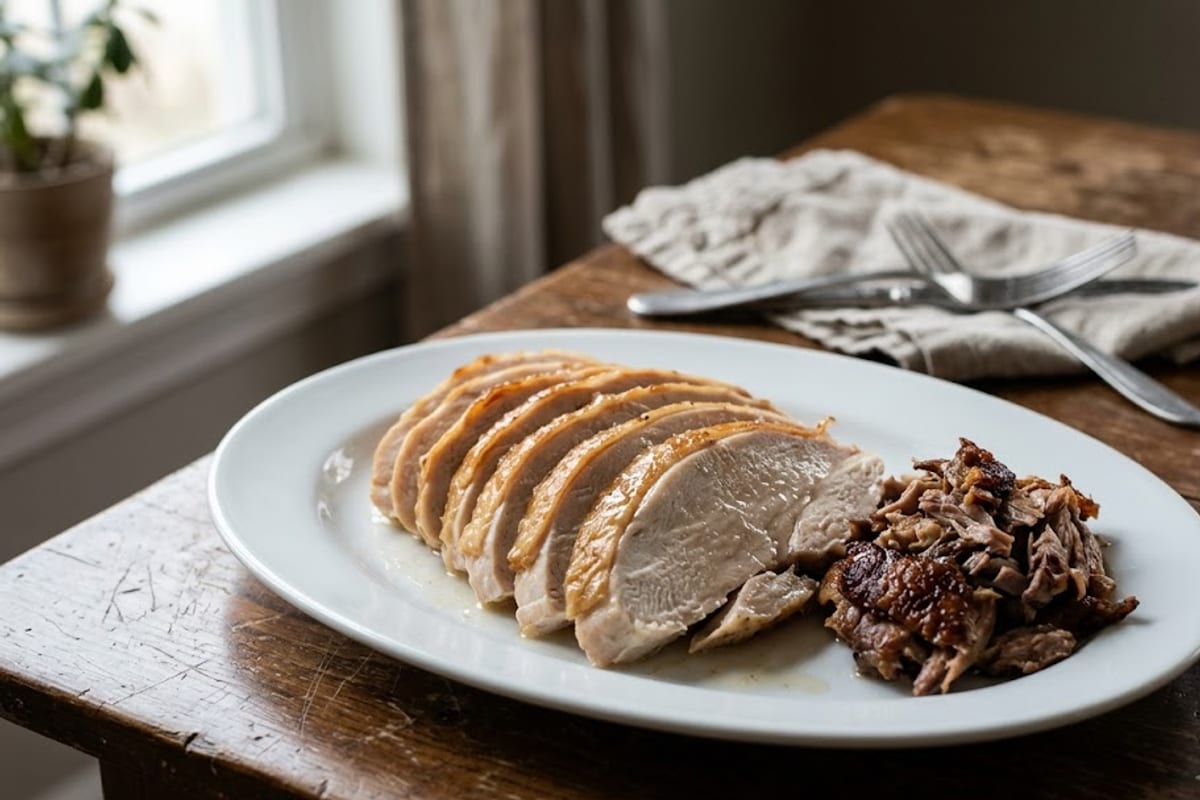
Let the turkey rest for 20 to 30 minutes after roasting. It stays hot for much longer than that. Tent it loosely with foil only if the kitchen is cold; tight foil softens the skin. Carve the breast off the bone in one piece and slice it across the grain for the most tender slices.
Ground turkey and turkey breast
Ground turkey, turkey burgers and turkey meatballs must reach 165°F, the same as other poultry. A boneless turkey breast roast is also cooked to 165°F; see turkey breast at 325°F for timing.
Thawing first
A turkey cooks evenly only when it is fully thawed. FSIS recommends three safe ways to thaw: in the refrigerator, in cold water or in a microwave. In the refrigerator, allow about 24 hours for every 4 to 5 pounds, so a 16 to 20 lb bird needs 4 to 5 days. In cold water, allow about 30 minutes per pound and change the water every 30 minutes, and cook the turkey immediately afterwards. A turkey still partly frozen in the cavity will reach 165°F in the breast long before the inner thigh.
It is safe to roast a turkey from frozen, but FSIS says it will take at least 50 percent longer, and the giblet package has to be removed with tongs partway through.
A turkey breast on the bone, sold on its own, is one of the easiest ways to avoid the breast and thigh problem altogether. It roasts in 1½ to 3¼ hours depending on size, according to the FSIS timetable, and there is only one kind of meat to watch. Legs and thighs can be braised separately for a second dish.
Frequently asked questions
What temperature is turkey done? 165°F in the innermost thigh, the innermost wing and the thickest part of the breast.
What temperature should I take the turkey out of the oven? When all three spots read 165°F, following USDA guidance. Some cooks pull at 160°F in the breast and rely on carryover, then check again after resting.
How long should turkey rest? FSIS recommends 20 minutes. Larger birds can rest 30.
What is 165°F in Celsius? 74°C.