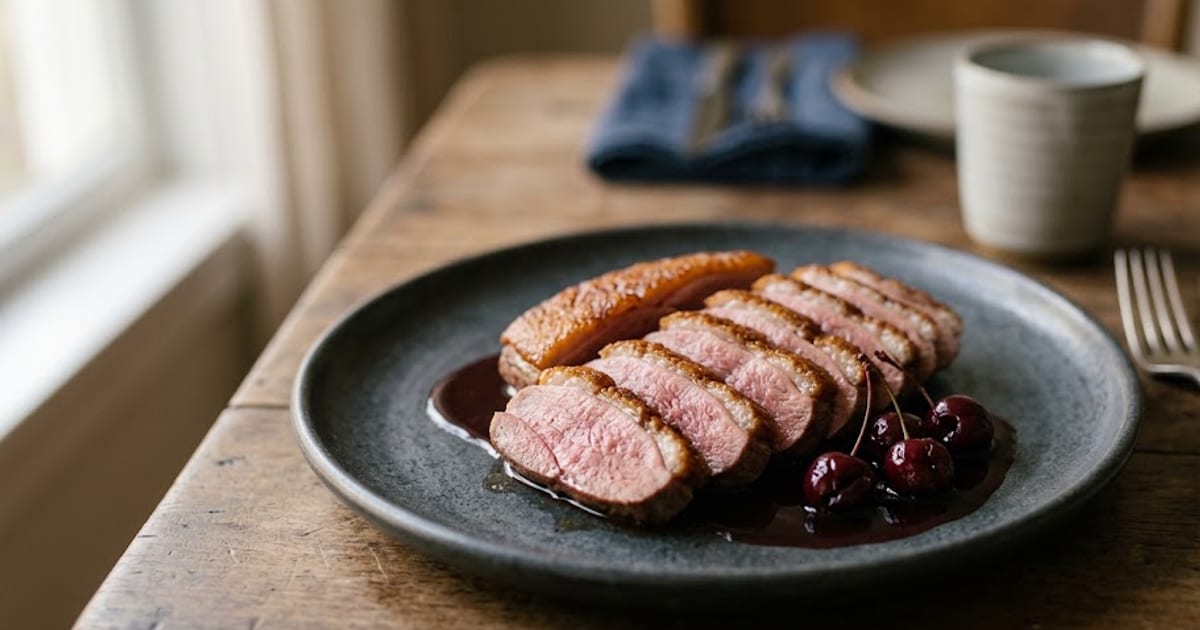
The USDA safe minimum internal temperature for duck is 165°F, for a whole bird and for every part: breast, legs, thighs and wings (FSIS, Duck and Goose from Farm to Table). In restaurants, duck breast is usually cooked like steak, to 130 to 140°F, and served pink. Duck legs are the opposite: they are tough at 165°F and taste best at 180°F or higher, often after long, slow cooking.
Duck temperature chart
| Cut | USDA safe minimum | Common culinary target | Pull at |
|---|---|---|---|
| Whole duck | 165°F in thigh, wing and breast | 165–175°F in the thigh | 160–165°F |
| Breast, pan-seared | 165°F | 130–135°F (medium rare) | 128–130°F |
| Breast, medium | 165°F | 135–140°F | 132°F |
| Legs, roasted or braised | 165°F | 180–195°F | 180°F+ |
| Leg confit | 165°F | Slow-cooked until tender, 190°F+ | By texture |
| Ground duck | 165°F | 165°F | 162°F |
The first column is the safety figure. The second is how duck is cooked in most restaurant kitchens. They are far apart for the breast, and the rest of this page explains why and how to decide.
Why duck breast is served pink
Duck and goose are classed as poultry, and FSIS calls them "white" meat for that reason. But ducks fly, and flight muscles are full of myoglobin, the protein that makes meat red. FSIS notes that because they are birds of flight, "the breast meat is darker than chicken and turkey breast" and that all the meat on a duck is dark.
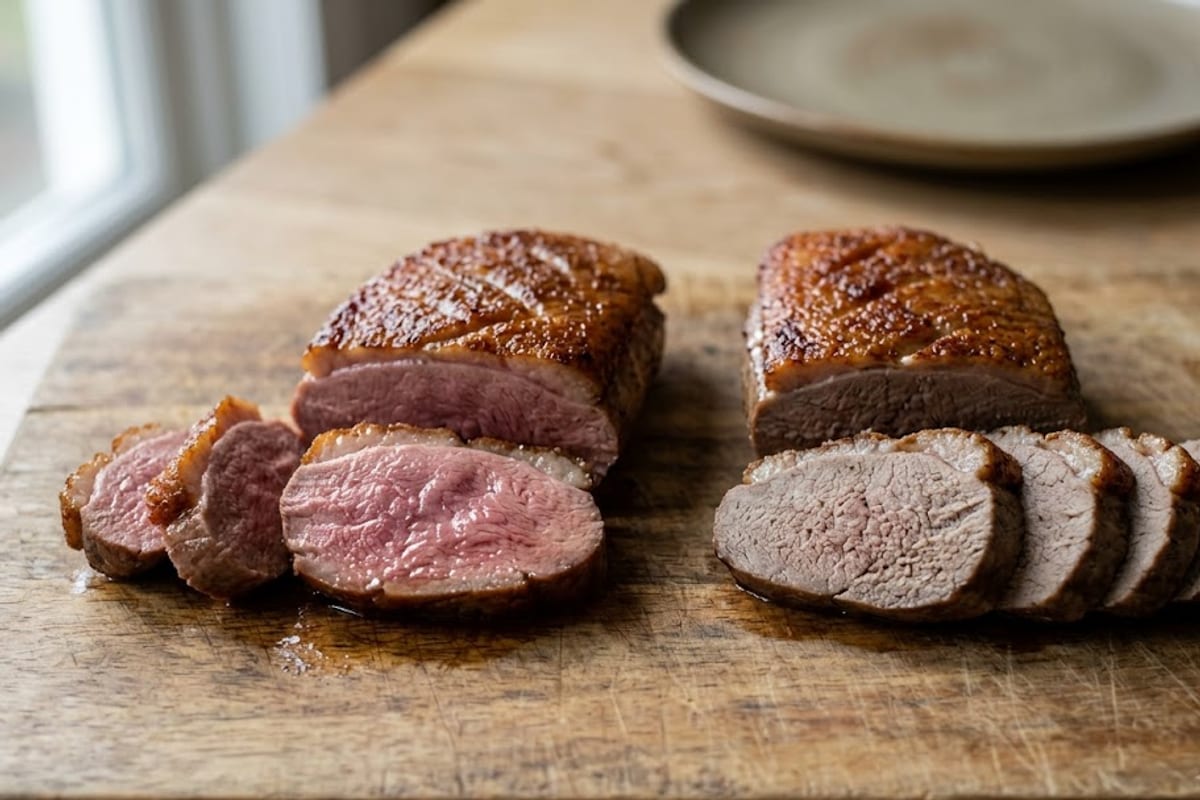
That dark, lean breast behaves much more like beef than like chicken breast. At 130 to 135°F it is tender and juicy with a clean, rich flavour. At 165°F it turns grey, dense and livery. That is why chefs treat it as a steak.
It is still poultry, though, and the safety guidance does not change with colour. Serving duck breast below 165°F is a choice that carries some risk. Pregnant people, young children, older adults and anyone with a weakened immune system should eat duck cooked to 165°F.
Duck breast, step by step
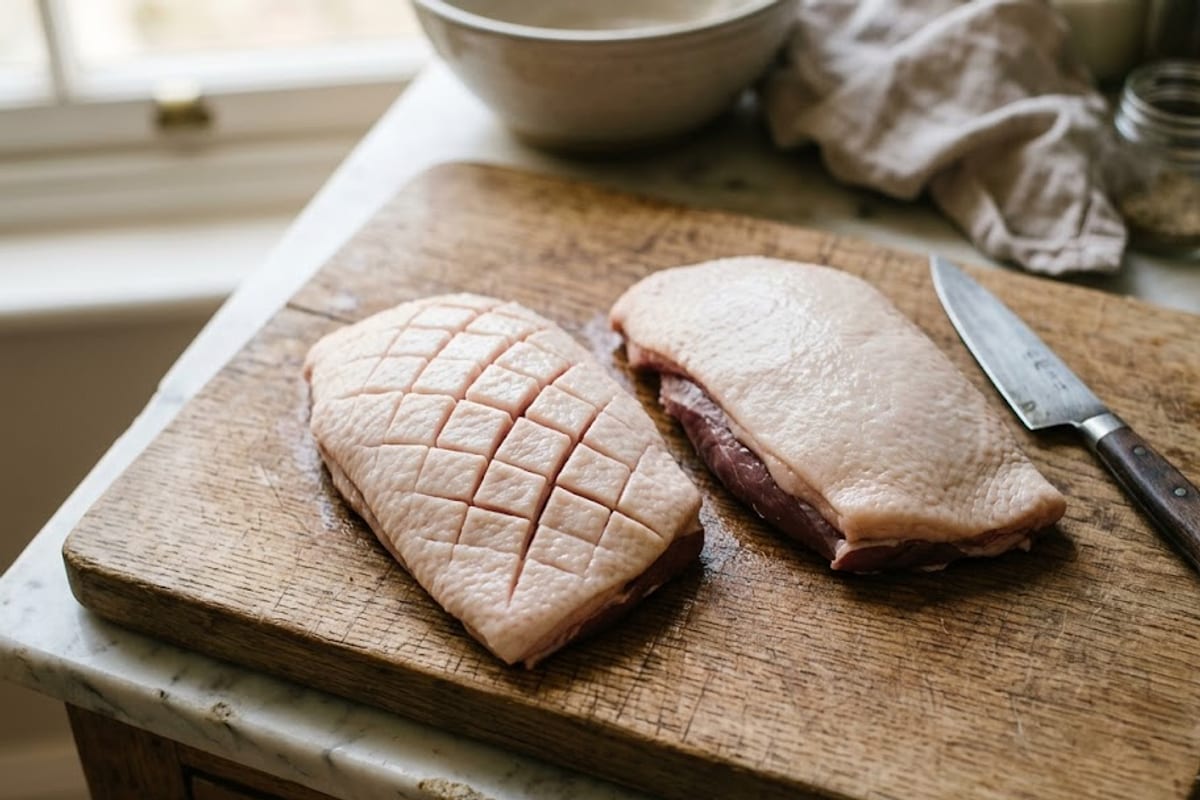
The breast has a thick layer of fat under the skin, often a quarter inch or more. Most of the work is rendering that fat without overcooking the meat under it.
- Score the skin in a crosshatch pattern, cutting through the fat but not into the meat. FSIS also recommends pricking the skin of whole birds so the fat can render out.
- Start skin side down in a cold or medium pan. Let the fat melt out slowly over 8 to 12 minutes, pouring off the fat as it collects, until the skin is deep golden and thin.
- Turn and finish on the flesh side for 1 to 3 minutes, or move the pan to a 400 to 425°F oven. FSIS gives a method of browning skin side down in a skillet over medium heat and then roasting at 425°F for 12 minutes.
- Check the temperature in the thickest part from the side. Pull at 128 to 130°F for medium rare, or keep going to 165°F if you are following the USDA figure.
- Rest 5 minutes skin side up, then slice across the grain.
Whole roast duck
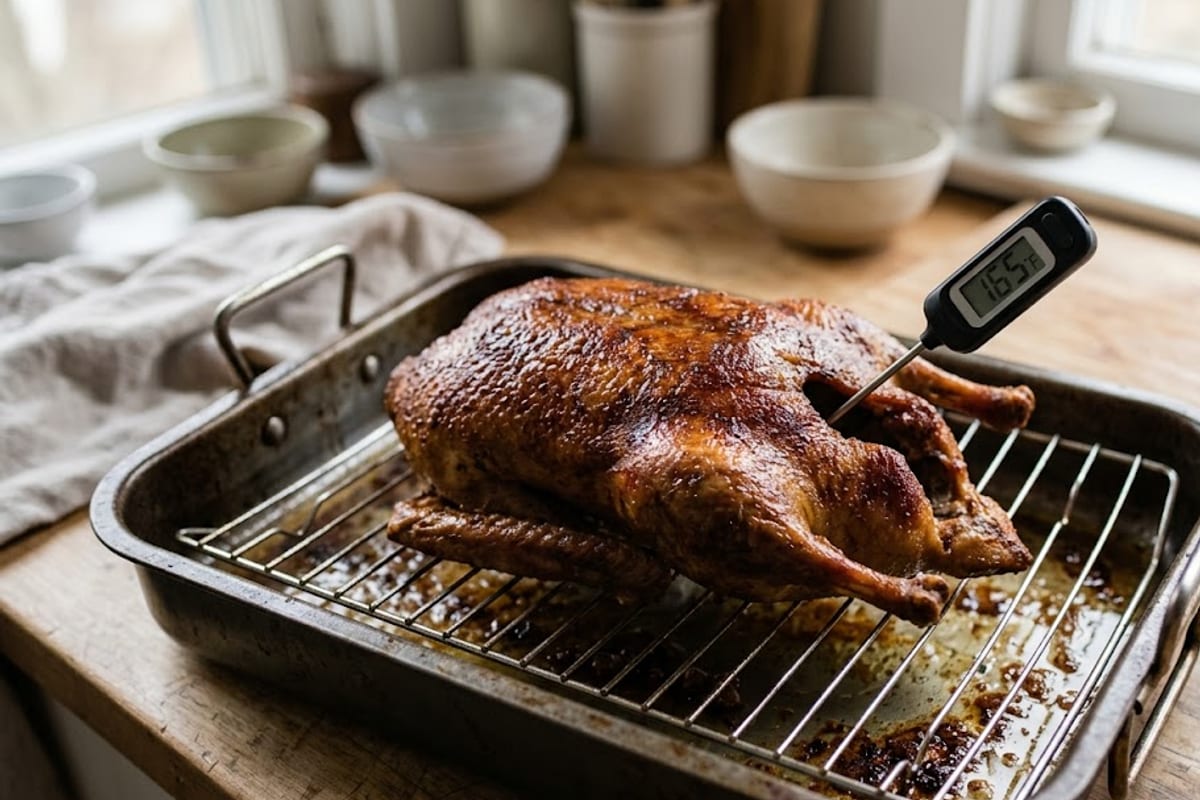
A whole duck is cooked to 165°F throughout. FSIS says to check "the innermost part of the thigh and wing and the thickest part of the breast". Because the breast and legs want different things, a whole roast duck is a compromise: the legs will be good at 165 to 175°F, and the breast will be well done.
FSIS gives a roasting time for a whole duckling of 4 to 6 lb of 30 to 35 minutes per pound at 350°F, and says not to stuff it. On a 5 lb duck that is about 2½ to 3 hours. Ovens vary, and higher oven temperatures shorten it, so start checking the thigh well before the end of the range. The fat layer should have fully rendered for the bird to be done; FSIS notes that it "must have melted and disappeared".
Some cooks split the difference by removing the breasts early and cooking the legs longer, or by roasting the legs separately. Chinese roast duck methods dry the skin for hours or overnight before roasting so it crisps faster, which also shortens the time the meat spends in the oven.
For oven times at other temperatures, see whole duck at 350°F and use the thermometer as the final check.
Duck legs
Legs and thighs are full of connective tissue. At 165°F they are safe but chewy. Cooked slowly to 180 to 195°F, the collagen turns to gelatin and the meat becomes tender enough to pull from the bone.
FSIS gives roasting times of 1¼ to 1½ hours at 325°F for duck legs or thighs, and braising for about 1½ hours. Confit, where legs are cooked slowly submerged in their own fat, usually takes 2 to 3 hours at 275 to 300°F. For all of these, texture is the real test: the meat should slide off the bone.
Duck is often pink even when fully cooked
Because duck meat is dark to begin with, it can look pink even at a safe temperature. FSIS addresses this directly: if duck has reached 165°F measured with a thermometer, "even though it may still be pink in the center, it should be safe". Pink colour can come from the cooking method or from ingredients. Colour alone does not tell you whether duck is cooked.
Rendered fat
A 5 lb duck can release more than a cup of fat. Pour it off during roasting so the bird is not sitting in it, and keep it in the fridge. Duck fat is excellent for roasting potatoes and vegetables at high heat.
Goose
Goose follows the same USDA figure, 165°F, for the whole bird and all parts (FSIS). It has even more fat than duck and needs its skin pricked all over so the fat can render. FSIS gives a roasting time of 2½ to 3 hours for a whole young goose of 8 to 12 lb, unstuffed. Goose breast, like duck breast, is dark meat and is sometimes cooked pink in restaurants, with the same caveat about safety.
Storing and reheating
FSIS gives these storage times for duck: fresh raw duck 1 to 2 days in the fridge or 6 months frozen; cooked duck 3 to 4 days in the fridge or 2 to 3 months frozen. Reheat cooked duck to 165°F.
To reheat roast duck without losing the crisp skin, warm it skin side up in a 350 to 375°F oven until hot through, then finish for a few minutes at a higher temperature or under the broiler. A microwave heats the meat but leaves the skin soft.
Never brown or partially cook a duck and then refrigerate it to finish later. FSIS warns that bacteria may not have been destroyed in the partial cooking. It is fine to partly cook duck in the microwave and move it straight onto a hot grill to finish.
Frequently asked questions
What temperature should duck be cooked to? The USDA safe minimum is 165°F for all duck. Duck breast is commonly served at 130 to 140°F, which is below that figure.
Can duck be eaten medium rare? It is common in restaurants and many home recipes. It is not the USDA recommendation, and people at higher risk should cook duck to 165°F.
What temperature is duck in Celsius? 165°F is 74°C. Medium rare breast is 54 to 57°C.
How long do you rest a duck? 5 minutes for a breast, 15 to 20 minutes for a whole bird.
For the same safe minimum on chicken and turkey, see how to tell if chicken is done and turkey internal temperature.