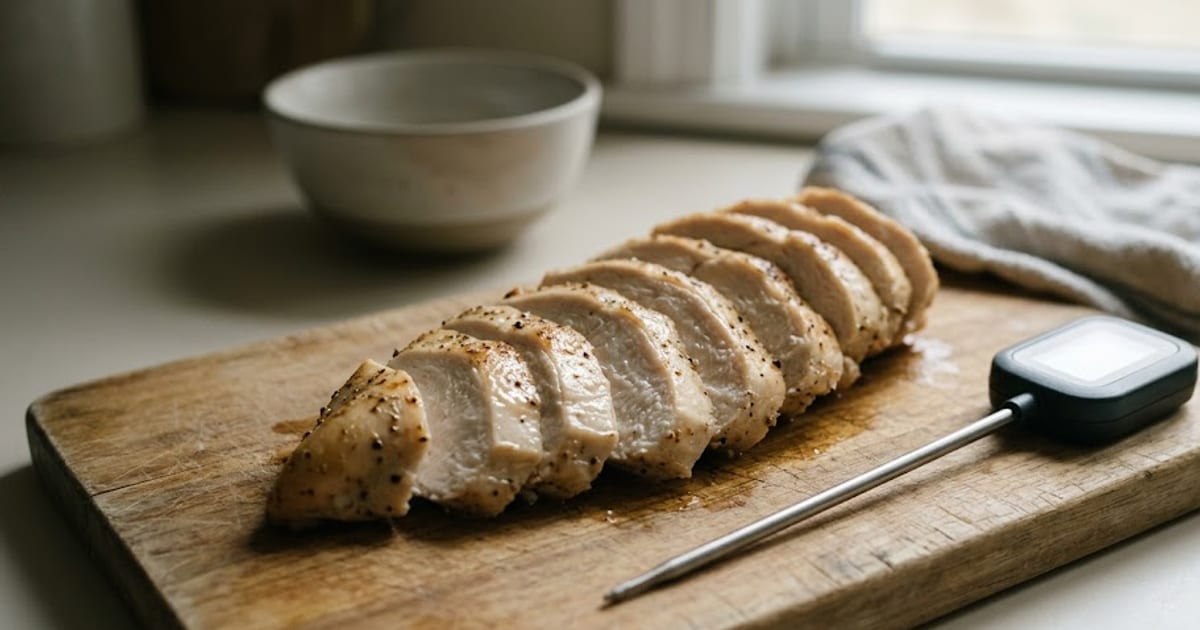
Boneless chicken breast: 20 to 22 minutes at 400°F. Bone-in, skin-on: 35 to 40 minutes at the same temperature.
Pull at 160°F, not 165. Carryover carries it the rest of the way, and those five degrees are the whole difference on a cut with no fat to protect it.
By temperature
| Oven | Boneless, 6–8 oz | Bone-in, skin-on |
|---|---|---|
| 350°F | 27–30 min | 45–52 min |
| 375°F | 23–26 min | 40–45 min |
| 400°F | 20–22 min | 35–40 min |
| 425°F | 17–19 min | 30–34 min |
| 450°F | 15–17 min | 27–30 min |
Why hotter is better for this cut
Most people bake chicken breast at 350°F because that is the default oven temperature in a hundred recipes. For this particular cut it is the wrong choice.
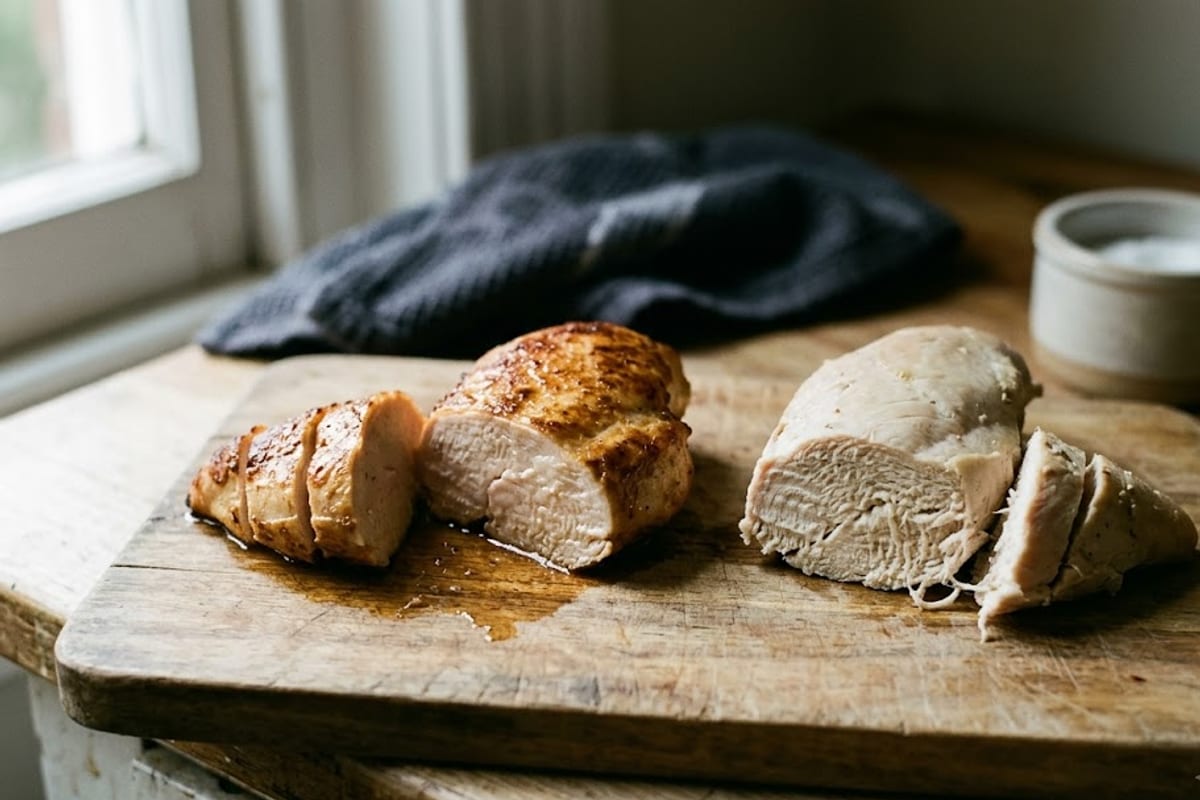
A breast at 350°F spends ten more minutes in the oven, and the outer half of the meat sits above 160°F for all of them, drying steadily while the centre catches up. At 425°F the surface browns and the centre arrives sooner, so less of the meat spends time overcooked.
The trade is that a very hot oven browns before the centre is ready on a thick breast — which is why 400 to 425 is the working range rather than 450.
Even thickness matters more than time
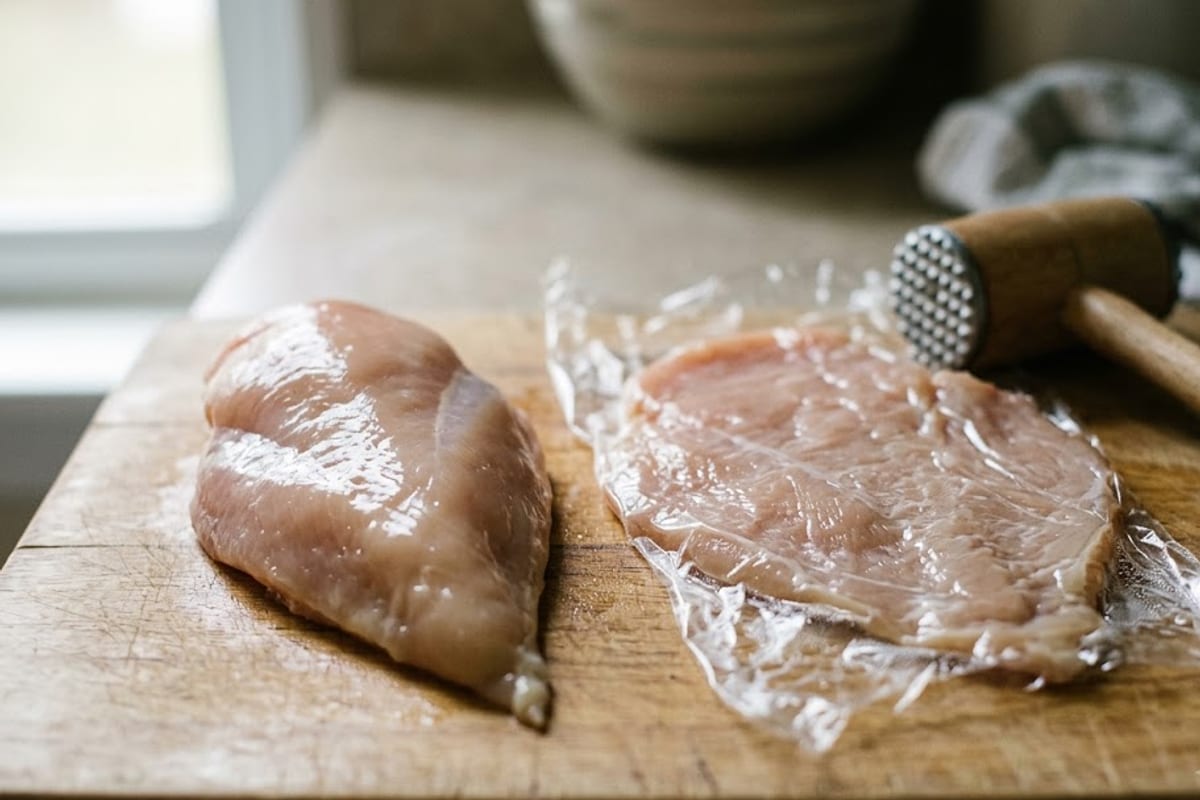
A supermarket chicken breast is commonly 1.5 inches at the thick end and half an inch at the tip. Those two ends cannot finish together, and no oven temperature fixes it.
Two ways to close the gap, both worth more than any adjustment to the clock:
Pound it to even thickness. Under plastic wrap, working from the thick end outward. A breast at a uniform ¾ inch cooks in 15 to 17 minutes at 400°F and comes out the same all the way along.
Butterfly it. Cut horizontally most of the way through and open it out. Same effect, and it doubles the surface for seasoning.
The brine that changes the outcome
Thirty minutes in a solution of ¼ cup salt per quart of water measurably changes how much moisture the meat retains. Salt dissolves some muscle protein and the meat holds water it would otherwise squeeze out at temperature.
A dry brine — salting the surface and leaving it uncovered in the fridge for an hour or more — does much the same and dries the skin at the same time, which is the better choice for bone-in pieces.
Neither is necessary. Both make a bigger difference on this cut than on any other in the kitchen.
What to do with the pan
Chicken breast releases liquid as it cooks, and where that liquid goes decides whether the underside browns or poaches.
A rimmed sheet pan with the pieces spaced apart lets it evaporate. A dish with sides holds it, and the bottom of the meat sits in simmering liquid at 212°F while the top browns — which is why the same recipe produces two different results in a baking dish and on a tray.
A wire rack set inside the pan removes the question entirely and is worth using for bone-in pieces, where the skin needs air underneath it to crisp.
Resting matters less here than on a roast, because a thin cut has little carryover to distribute. Five minutes is enough, and covering it with foil in that time softens whatever crust you built for no benefit.
Reading it right
Probe from the side, into the thickest part, horizontally. A breast is not deep enough for a top-down probe to sit anywhere useful.
Colour is not a doneness test in either direction. Chicken can stay slightly pink at the bone at 165°F, and it can be white and overcooked at 175°F. The probe is the only honest answer, and the doneness table sets out where the safe number and the good number differ.
Bone-in pieces behave differently again — the thigh next to it wants a much higher final temperature, which is the reason a whole bird is two different cooking problems in one.