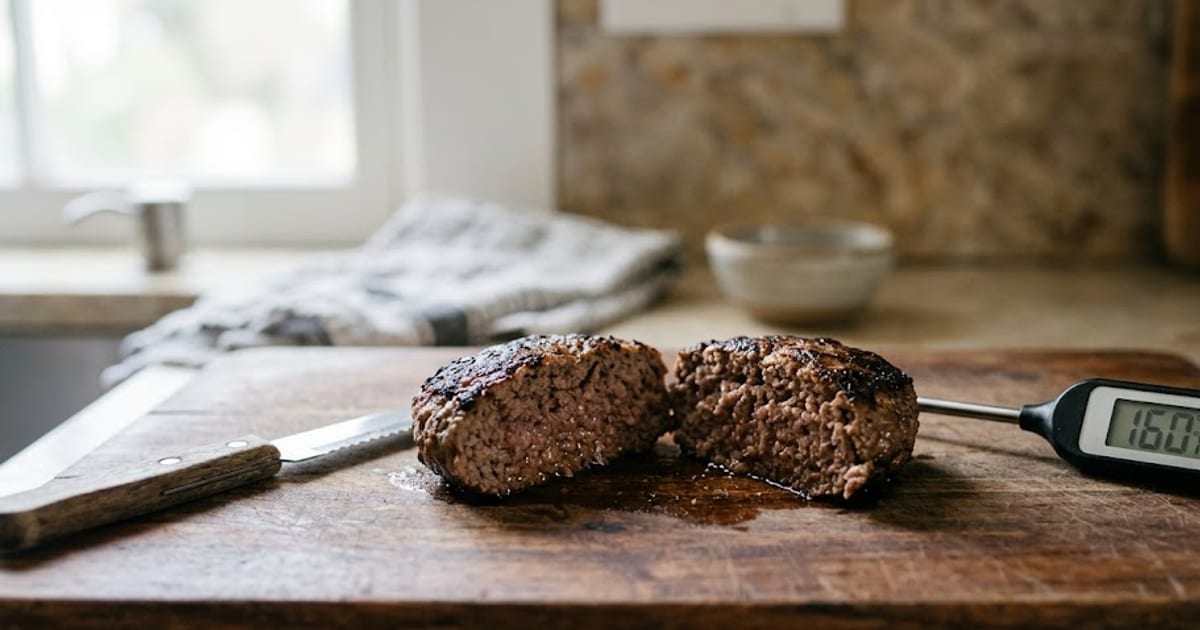
160°F. That is the USDA safe minimum for ground beef, and unlike the steak numbers it is not a conservative reading of a lower real threshold.
| Safe minimum | |
|---|---|
| Ground beef, pork, lamb, veal | 160°F |
| Ground chicken and turkey | 165°F |
| Whole-muscle steak | 145°F + 3 min rest |
Why grinding changes everything
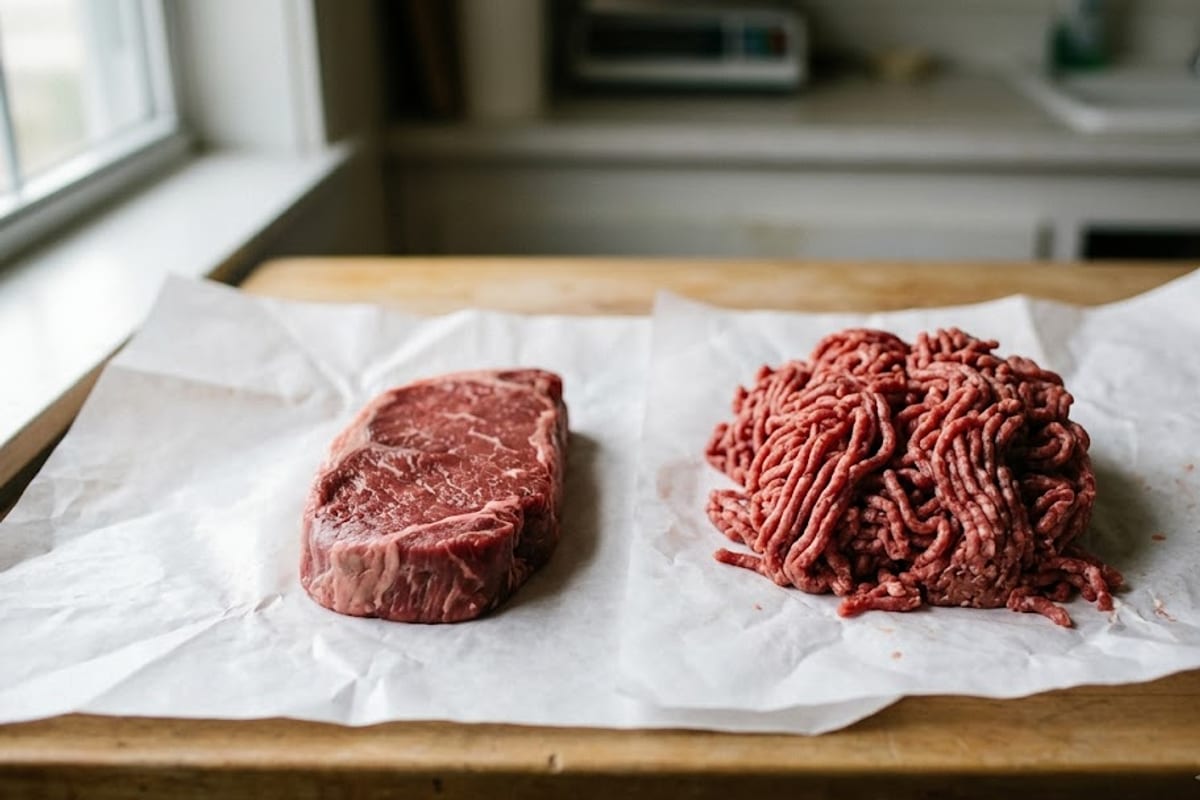
A steak carries its bacterial risk almost entirely on the outside. The interior of an intact muscle is close to sterile, and a sear takes the surface far past any lethal threshold in seconds. That is the reasoning that makes a medium-rare steak a normal thing to serve.
Grinding takes that surface and distributes it through the entire mass. Every part of a burger patty was, at some point, the outside of something — and no sear reaches the middle.
It is not a stricter version of the steak rule. It is a different problem with a different answer, and the widespread belief that a rare burger is "the same as a rare steak" is the single most common misunderstanding in home cooking.
E. coli O157:H7 is the specific concern, and it is unusual in needing only a very small number of organisms to cause illness.
The doneness table, for context
These are the temperatures the stages correspond to. Only the last two are at or past the safe minimum.
| Stage | Temp | Safe? |
|---|---|---|
| Rare | 125°F | No |
| Medium rare | 135°F | No |
| Medium | 145°F | No |
| Medium well | 155°F | Approaching |
| Well done | 160°F+ | Yes |
Restaurants that serve burgers below 160°F do so under a written health-department procedure, usually involving beef ground in-house from whole cuts that day, and a consumer advisory on the menu. That is a controlled process, not a preference.
Grinding your own changes the arithmetic, a little
If you grind whole cuts yourself, immediately before cooking, from meat whose surface you have just seared or trimmed, the risk profile moves closer to that of steak — because you know what went in and how long ago.
It does not move all the way. A domestic grinder is not sterile, and the meat spends time at room temperature during grinding. Anyone doing this for children, older adults, pregnant women or the immunocompromised should still cook to 160°F.
How to hit 160 without a dry burger
The complaint about 160°F is that it produces a dry patty. That is usually a fat problem rather than a temperature problem.
Use 80/20 ground chuck. At 20% fat there is enough rendering fat to keep a 160°F patty juicy. At 93/7 there is not, at any temperature.
Make the patty wider and thinner, not thicker. A ¾-inch patty spends less time with its outer half overcooked while the centre climbs. A smashed patty gets there almost instantly and browns hard at the same time.
Do not press it on the grill. Pressing squeezes out exactly the rendered fat that was going to keep it moist, and it does nothing for browning.
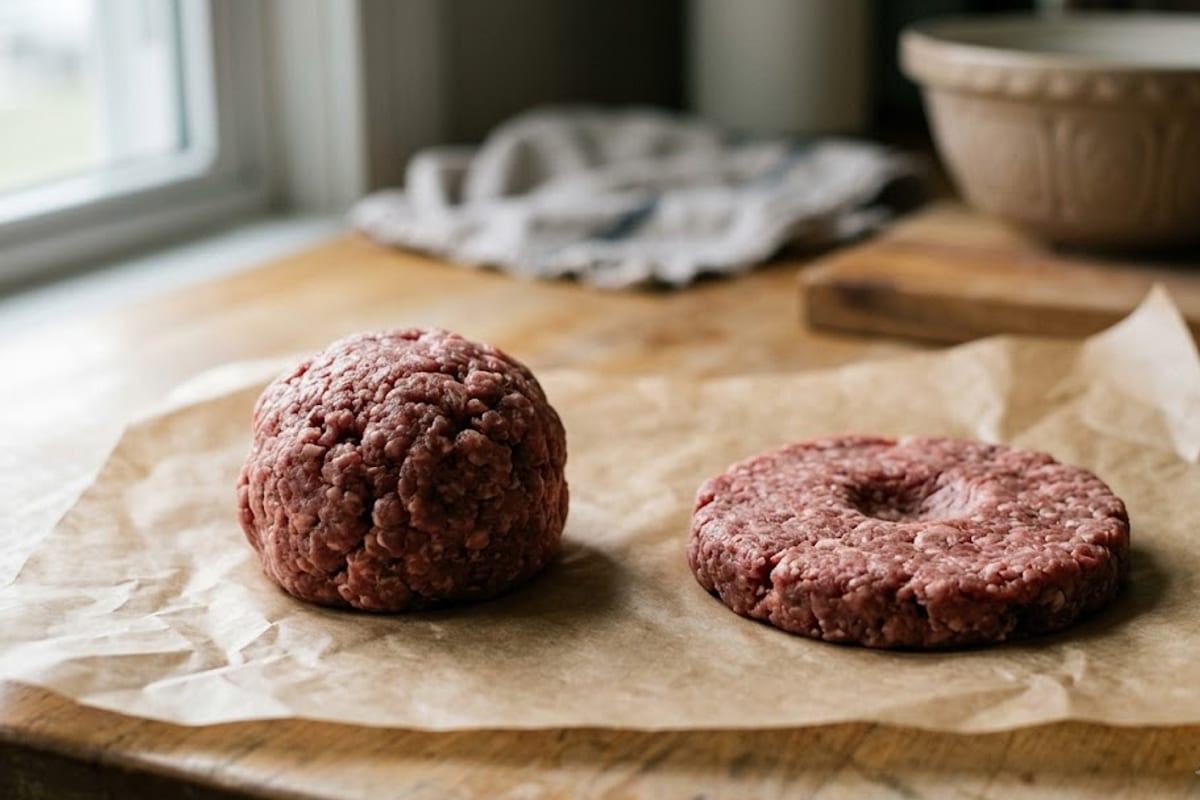
Dimple the centre. A shallow thumbprint in the middle stops the patty doming as the proteins contract, which keeps thickness even and cooking time predictable.
Probing a patty
From the side, horizontally, into the centre. A patty is not thick enough for a top-down reading to land anywhere meaningful, and an instant-read thermometer with a thin probe is the only kind that works on something this thin.
Carryover on a burger is small — 2 to 3°F — so unlike a roast, the pull temperature and the serving temperature are nearly the same. Pull at 158 and it lands on 160.
Poultry burgers follow the chicken rules instead, at 165°F.