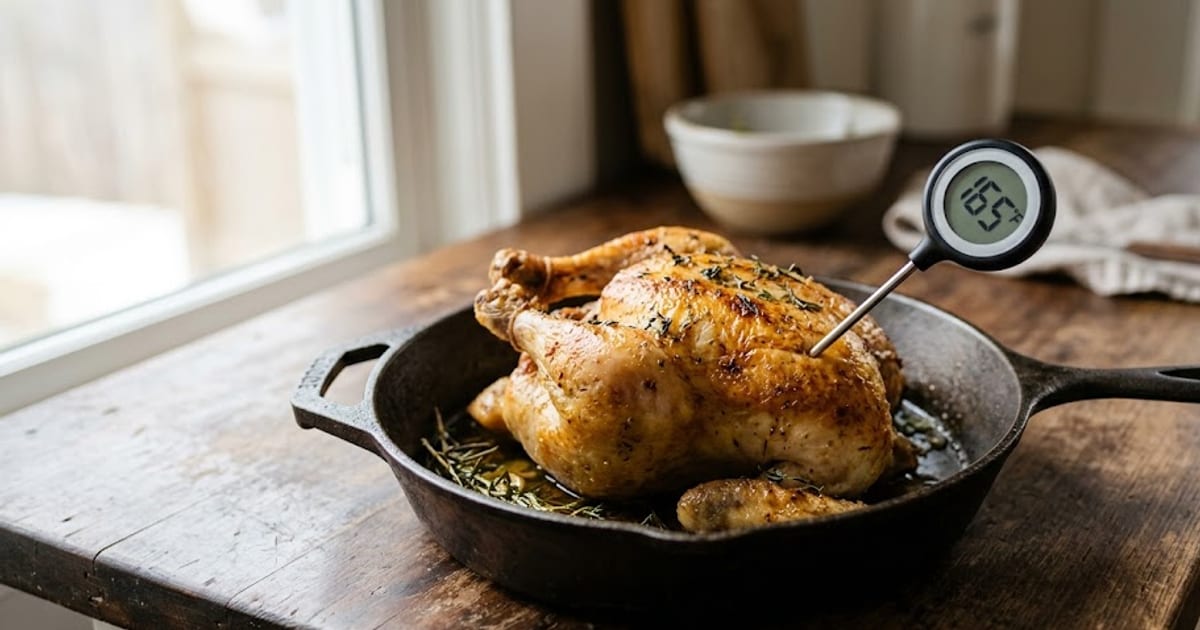
Chicken is safely cooked when the thickest part reaches 165°F on a food thermometer. That is the USDA figure for all poultry, whole birds and every part, including ground chicken (FoodSafety.gov). Without a thermometer, the signs are opaque white meat in the centre, clear rather than pink juices, firm flesh and, on a whole bird, a leg that moves loosely in its joint. None of those signs is as reliable as the thermometer, and each can be misleading in a particular way.
With a thermometer
Put the probe into the thickest part of the piece, away from bone.
| Piece | Where to measure | Safe minimum | Many cooks aim for |
|---|---|---|---|
| Breast, boneless | Centre of the thickest end, from the side | 165°F | 160°F pulled, 165°F after resting |
| Breast, bone-in | Thickest part, not touching the bone | 165°F | 160–165°F |
| Thigh, leg | Thickest part near the bone, not touching it | 165°F | 175–185°F for texture |
| Wings | Meatiest part of the drumette | 165°F | 175°F+ |
| Whole bird | Innermost thigh, wing and thickest breast | 165°F in all three | Thigh 175°F, breast 160–165°F |
| Ground chicken | Centre of the patty or meatball | 165°F | 165°F |
Bone conducts heat and reads high; pockets of fat read low. On a whole bird, check the thigh first, since it is usually the slowest part, then the breast. FSIS gives the same three spots for a whole bird: innermost thigh, innermost wing and thickest part of the breast (FSIS, turkey roasting guide).
Without a thermometer
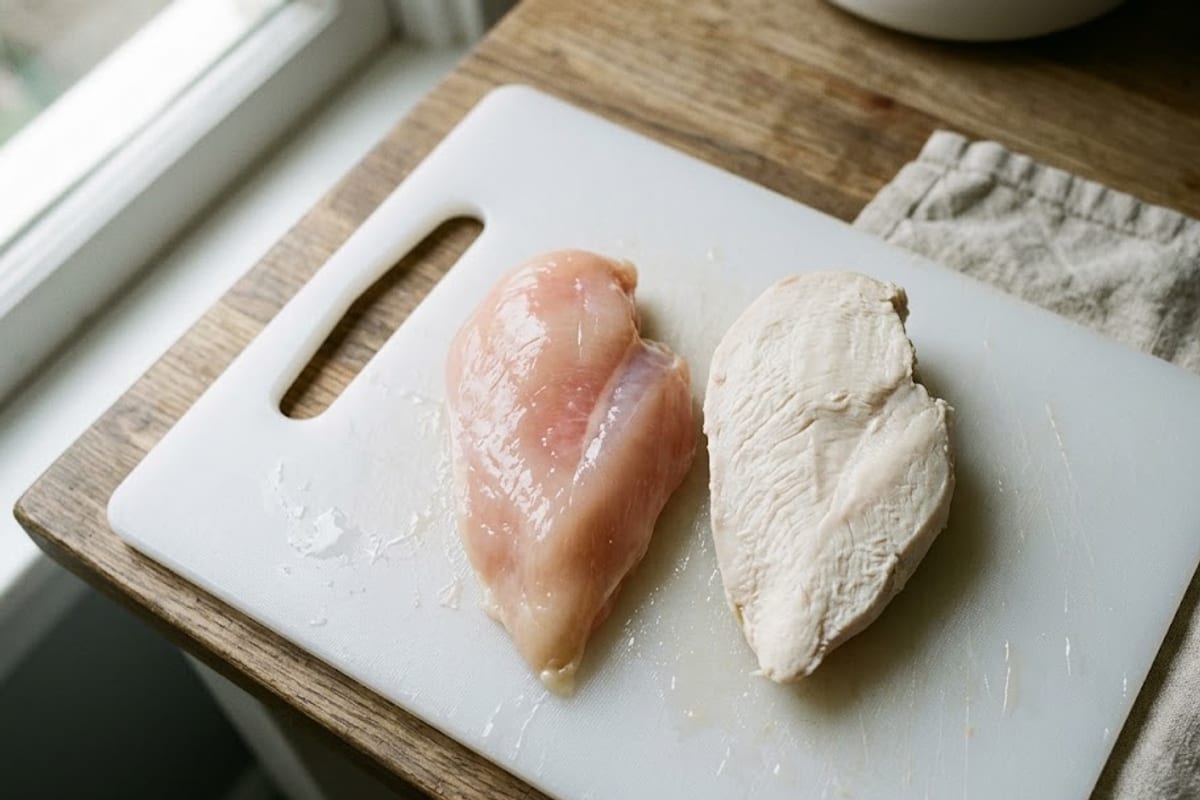
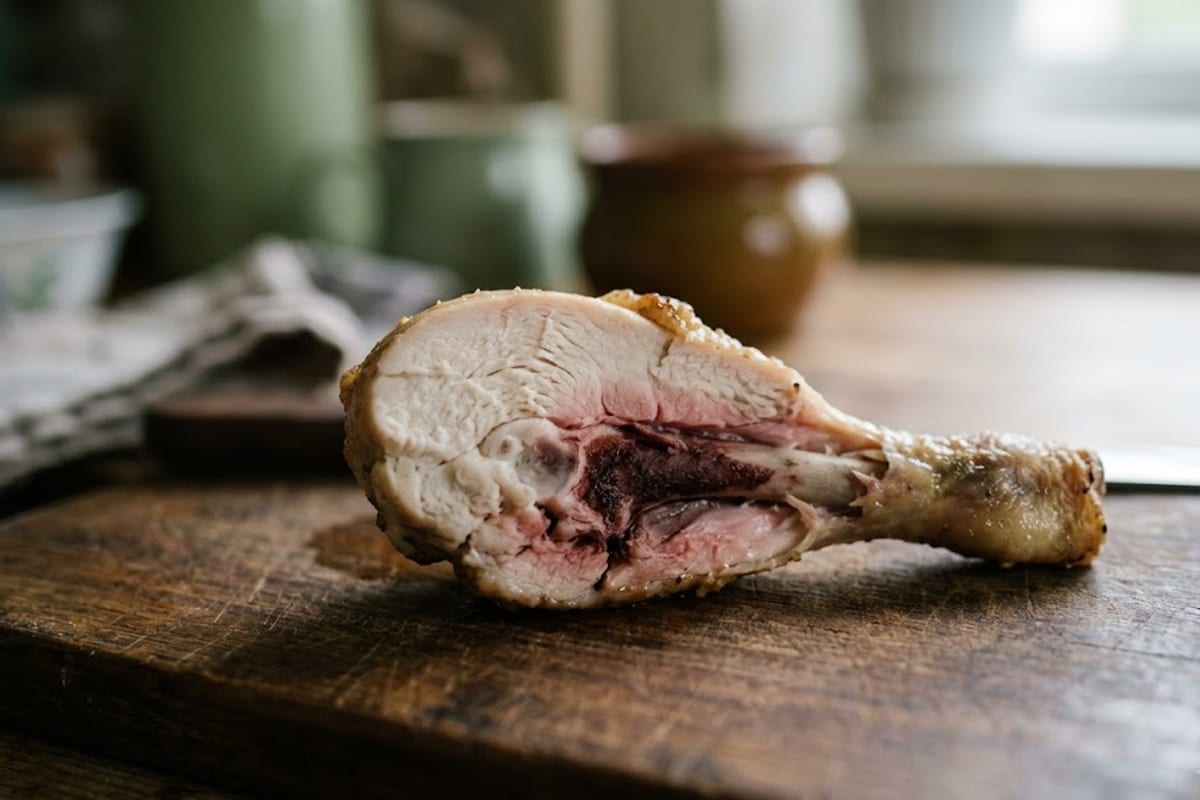
Cut into the thickest part. Cooked chicken is white or light tan and opaque. Undercooked chicken breast looks glossy, pink and slightly translucent in the centre, and the fibres cling together rather than separating. This is the most useful visual check, and on a single breast it is quick to do.
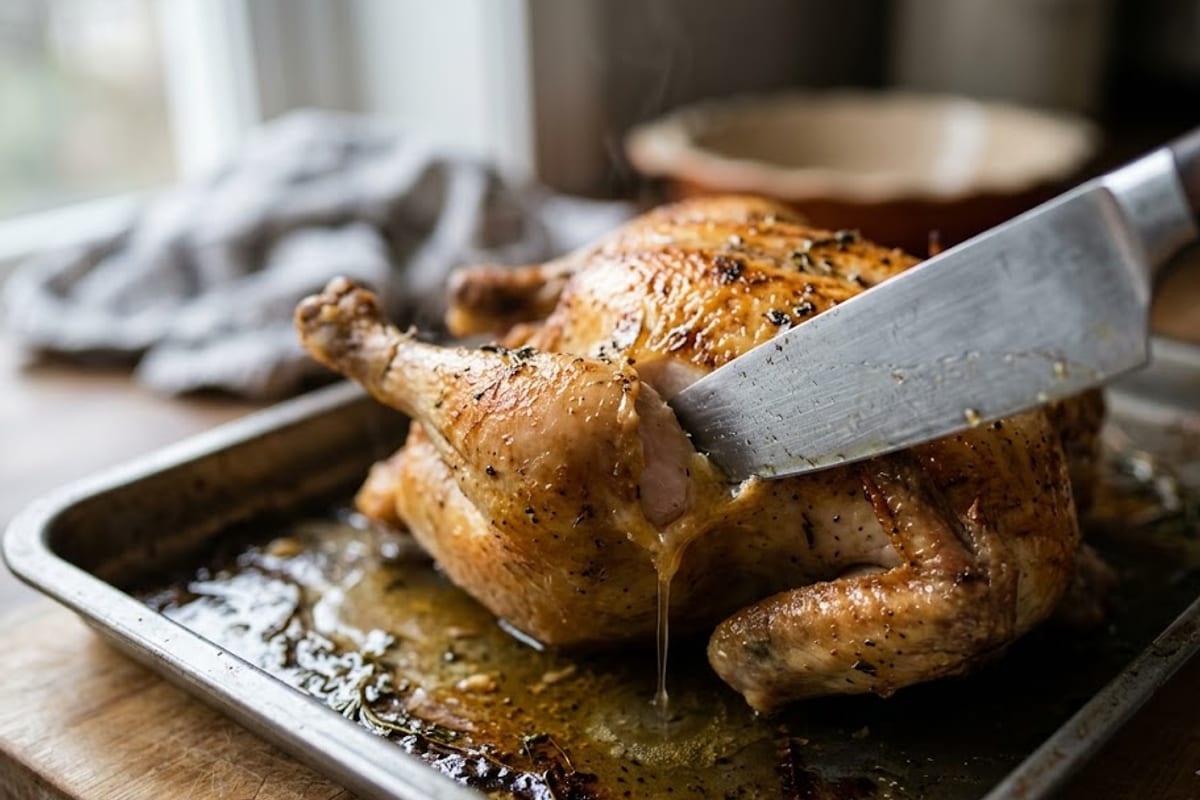
Look at the juices. Pierce the thickest part, or the joint between thigh and body on a whole bird, and press. Clear or golden juice suggests the meat is cooked. Pink or cloudy red juice suggests it is not. Juice colour depends on pigment as much as on temperature, so treat it as a hint.
Press the meat. Raw chicken is soft and yields under a finger. Cooked breast is firm and springs back. This takes practice and varies with the thickness of the piece.
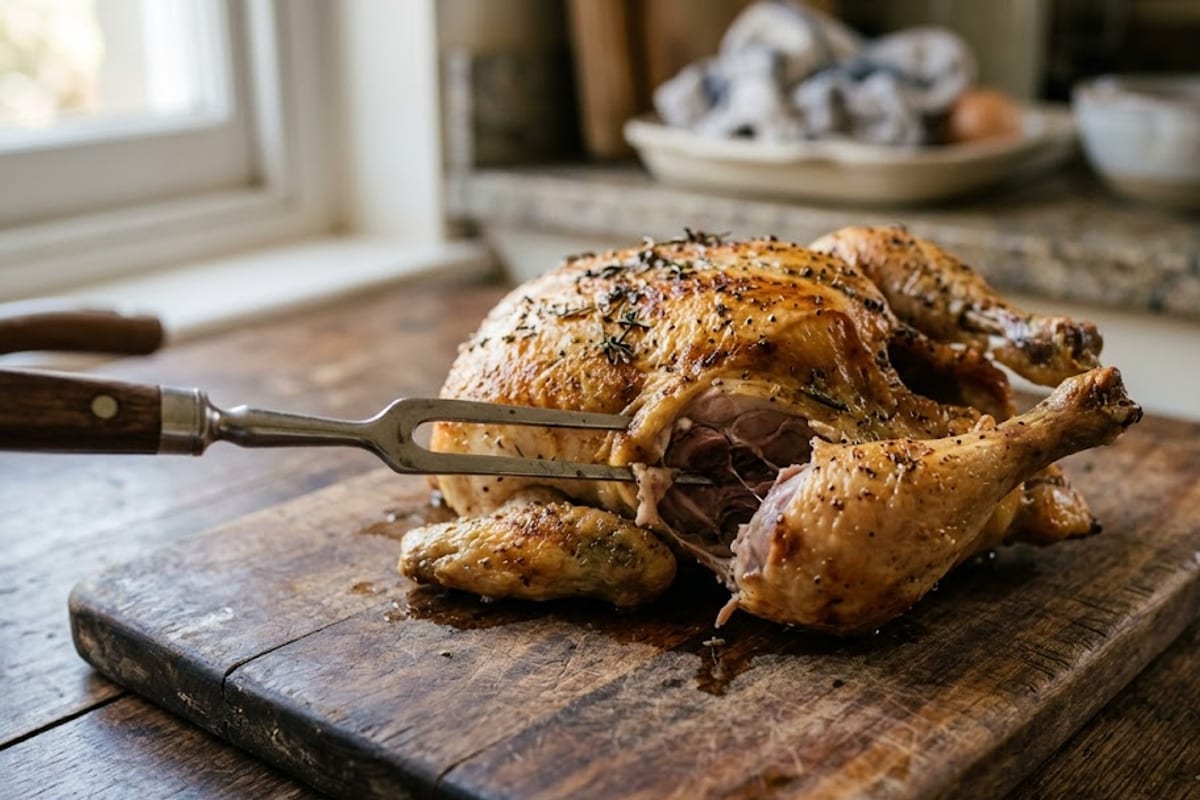
Move the leg. On a whole bird, a cooked drumstick wiggles freely and the joint loosens. It also tends to show up late, when the breast may already be overcooked.
Check the time. Time only tells you when to start checking. A 6 to 8 ounce boneless breast at 400°F usually takes 18 to 22 minutes, and bone-in thighs 26 to 34 minutes; see chicken breast at 400°F and chicken thighs at 400°F.
When pink is not undercooked
FSIS states plainly that colour "is not always a sure sign" of safety, and that poultry "can remain pink even after cooking to a safe minimum internal temperature of 165 F" (FSIS, Is Pink Turkey Meat Safe?). Common reasons, most of them described on that FSIS page:
- Young birds. Most chicken is slaughtered young. Thin skin lets oven gases reach the meat, and they react with the pigment to leave a pink tinge.
- Bone marrow. In young birds, pigment from the marrow can seep through the porous bones and colour the meat right next to the bone reddish-pink, especially in legs and thighs.
- Grilling and smoking. Smoke produces a pink ring up to about half an inch deep that stays pink however long the meat cooks.
- Nitrites. Naturally present in feed or water, or added in brines, they fix a pink colour the way curing does in ham.
The reverse also happens. Chicken can look white and still be under 165°F, particularly if it was frozen and thawed. This is why FSIS repeats that only a thermometer settles it.
Why 165°F, and why some cooks pull lower
165°F is the temperature at which the Salmonella count drops by the target amount instantly. Lower temperatures achieve the same reduction if the meat stays there long enough. The FSIS time and temperature tables for poultry, used for commercial cooking, give holding times for lean chicken (about 2% fat) such as these (FSIS poultry lethality tables, reproduced by RiverStone Health):
| Internal temperature | Hold for the same reduction |
|---|---|
| 145°F | 8.6 minutes |
| 150°F | 2.7 minutes |
| 155°F | 45 seconds |
| 160°F | 14 seconds |
| 165°F | Under 10 seconds |
A chicken breast pulled at 160°F usually rises a few degrees while it rests and stays above 155°F for well over a minute, which is why many chefs pull breast meat at 155 to 160°F. That approach relies on accurate measurement and on the rest actually happening. For home cooking, and for anyone at higher risk, the 165°F figure is the safe choice.
Dark meat is a different target
Thighs and legs are safe at 165°F, but they are not at their best there. They contain more connective tissue, which starts to soften above about 170°F. At 175 to 185°F, thigh meat is tender and juicy; at 165°F it is chewy and can look pinkish near the bone. Cooking dark meat hotter makes it better, not drier. The details are in chicken thigh internal temperature.
Common mistakes
- Checking only one piece. In a pan of breasts of different sizes, the largest one decides when everything is done.
- Measuring through the top. On a thin breast, a probe pushed down from above ends up near the pan and reads high. Go in from the side.
- Relying on a pop-up timer. FSIS recommends checking a bird with a pop-up indicator with a thermometer too.
- Cutting straight away. Resting 5 minutes for pieces and 15 minutes for a whole chicken lets the temperature finish rising and keeps the juices in the meat.
Choosing and checking a thermometer
An instant-read digital thermometer with a thin probe gives a reading in two to four seconds and is the most useful tool for chicken pieces. For whole birds and roasts, a leave-in probe with a cable to a display outside the oven lets you watch the temperature without opening the door.
Check accuracy before relying on one. Put the probe in a glass full of ice with a little water, stirred, for 30 seconds; it should read 32°F. If it is off by more than a degree or two, adjust it if it has a calibration setting, or allow for the difference when you cook.
Clean the probe between readings of raw and cooked meat. A probe that went into raw chicken and then into a cooked piece can carry bacteria across.
Undercooked chicken after cutting
If you cut into chicken and it is not done, put it back straight away. Pieces can go back into the pan or oven; a whole bird can be cut into pieces so it finishes faster. Do not leave partly cooked chicken to sit and finish later, and do not refrigerate it to cook again another day. Continue cooking until the thickest part reads 165°F.
Frequently asked questions
Can chicken be a little pink and still be safe? Yes, if it has reached 165°F. Pink near the bone and a pink ring from smoke are common in fully cooked chicken. Use a thermometer to be sure.
Is chicken done if the juices run clear? Usually, but not always. Clear juices are a helpful sign, not proof.
How long does chicken take to cook? It depends on the cut and thickness. Boneless breasts take 18 to 22 minutes at 400°F; a whole 4 lb chicken takes a little over an hour. The full temperature guide is in internal temperature for chicken.
What if I undercooked it? Put it back in the oven or pan until the thickest part reaches 165°F. It is safe to continue cooking straight away.