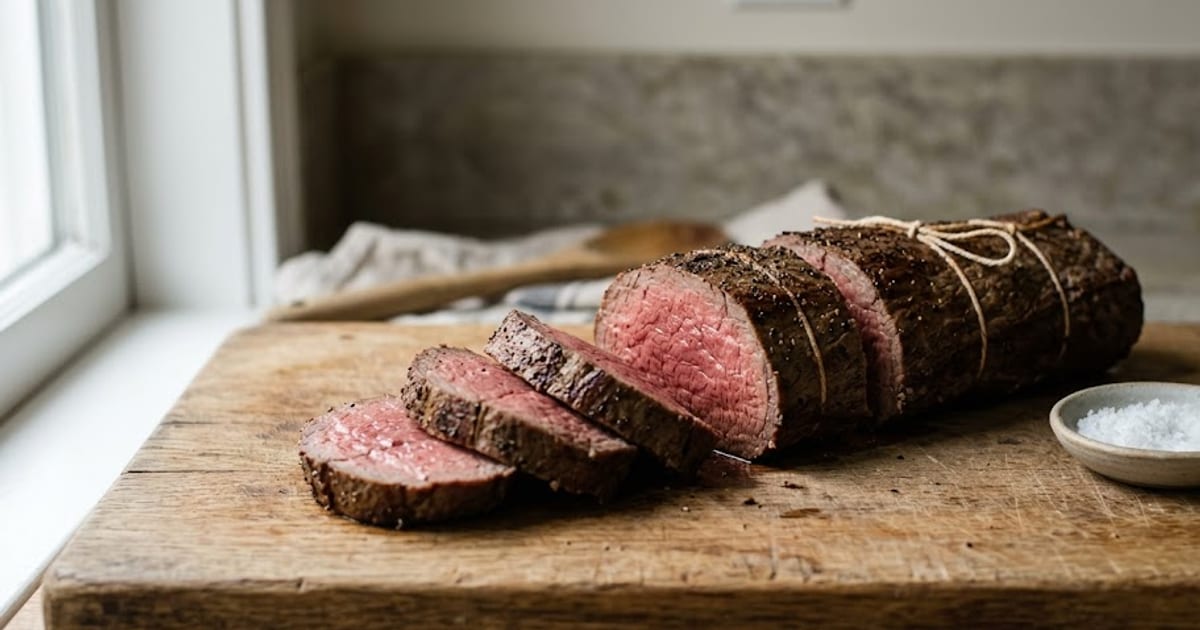
Beef tenderloin is medium rare at 130 to 135°F. Take a whole tenderloin roast out of the oven when the thickest part reads 125°F, and it will rise another 5 to 8°F as it rests. For medium, pull at 135°F. The USDA safe minimum for beef roasts is 145°F with a 3-minute rest (FoodSafety.gov), which is medium well on the chart below.
Beef tenderloin temperature chart
| Doneness | Pull the roast at | After resting | Centre |
|---|---|---|---|
| Rare | 115–120°F | 120–125°F | Deep red |
| Medium rare | 125°F | 130–135°F | Warm red |
| Medium | 135°F | 140–145°F | Pink |
| Medium well | 145°F | 150–155°F | Faint pink |
| Well done | 155°F | 160°F+ | No pink |
For individual filet mignon steaks, which carry over less than a whole roast, pull about 3 to 5°F below the serving temperature you want instead of 7 to 8.
Why tenderloin is less forgiving than other roasts
The tenderloin is the muscle along the inside of the spine that does very little work. That makes it the most tender cut on the animal, and also the leanest. It has almost no marbling and very little connective tissue.
Fat and collagen are what keep other roasts pleasant when they are overcooked. A prime rib at medium well is still rich because its fat has rendered through the meat. A tenderloin at medium well has nothing to fall back on and tastes dry and mealy. This is the reason most recipes and restaurants serve it rare or medium rare, and why the pull temperature matters so much.
The roast is also narrow, so it heats quickly. At 425°F a trimmed 3 lb centre-cut tenderloin reaches 125°F in roughly 28 to 36 minutes (tenderloin at 425°F). In the last ten minutes it can rise several degrees a minute.
The tail problem
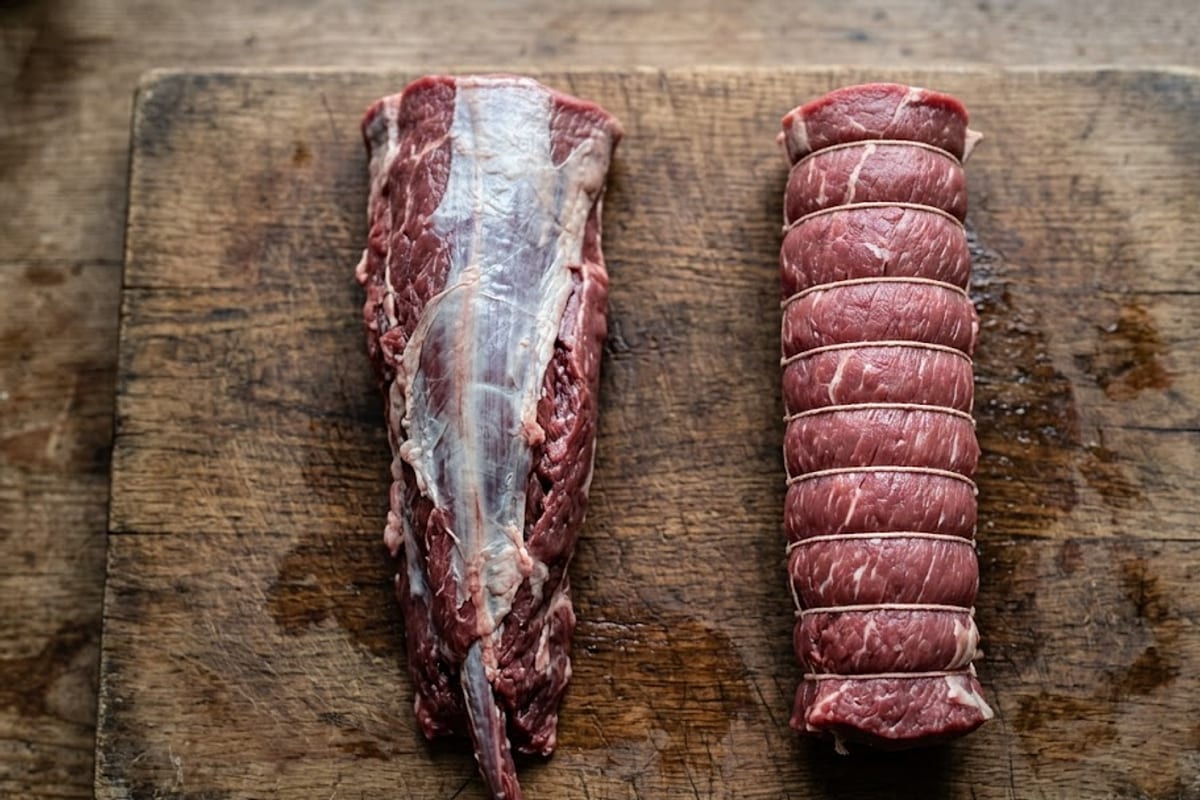
A whole tenderloin tapers from a thick head at one end to a thin tail at the other. Cook it as it comes and the tail is well done long before the head is medium rare.
There are three common fixes:
- Fold and tie. Tuck the thin tail under itself and tie the roast with twine every inch or so. This makes a cylinder of even thickness that cooks evenly.
- Cut it off. Remove the tail and cook it separately as steaks or strips, or use it in a stir fry.
- Use it on purpose. Leave the tail as it is and serve those slices to guests who want well done.
Trimming also matters. A whole "PSMO" tenderloin, which stands for peeled, side muscle on, comes with a chain muscle along one side and a tough layer of silver skin on top. Removing both before cooking makes the roast even and stops the silver skin from shrinking and bending the meat as it cooks.
Where to put the thermometer
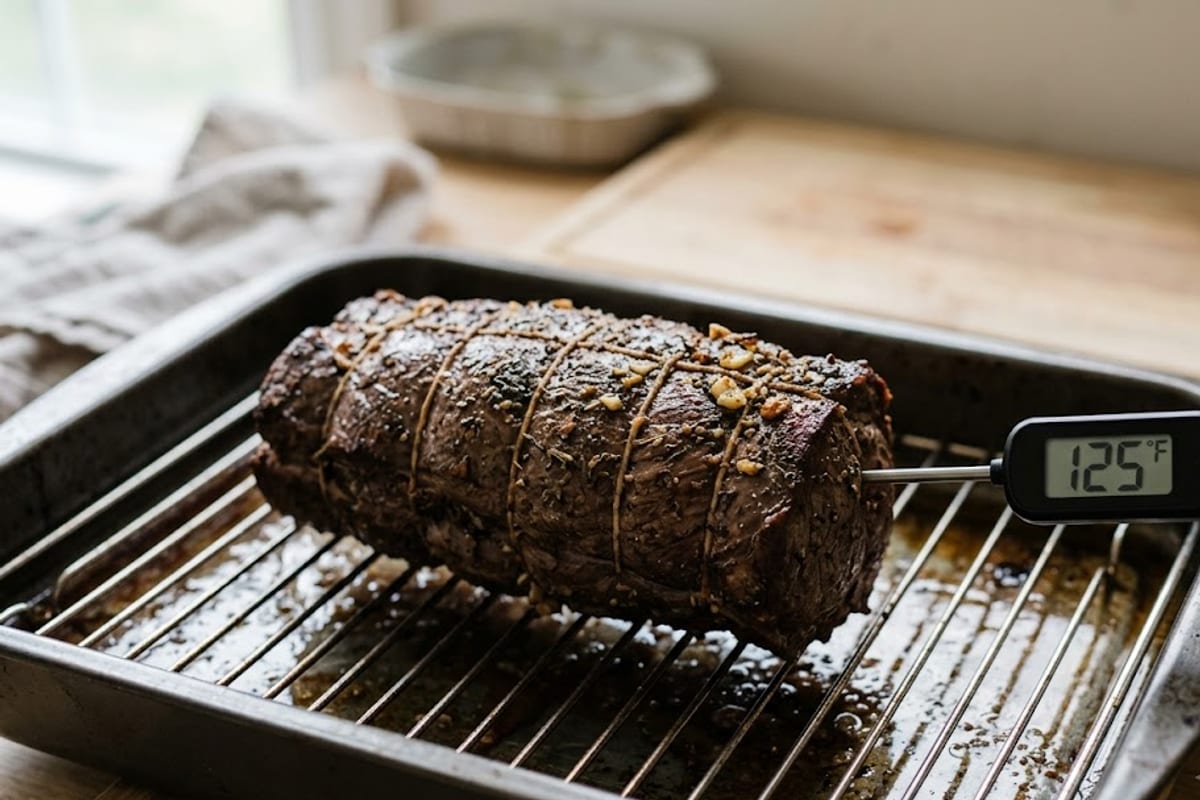
Insert the probe horizontally from one end, or from the side, into the thickest part of the roast, and push until the tip is in the middle. Check two or three places along the length. On a tied roast they should be within a few degrees of each other. If one end is running far ahead, turn the roast or cover that end with a strip of foil.
A leave-in probe thermometer with an alarm is useful for this cut, because it tells you the moment the roast reaches 125°F without opening the oven. Set the alarm a couple of degrees early the first time you use it with a new oven.
Oven temperature and method
Hot and fast, 425 to 450°F. Sear the roast in a pan first, or roast it hot the whole way. It takes 25 to 40 minutes for a 2 to 4 lb piece. The outer layer overcooks slightly, leaving a band of grey under the crust.
Low then hot, the reverse sear. Roast at 250 to 275°F until the centre reads about 120°F, which takes 60 to 90 minutes, then sear in a very hot pan or under a broiler for a crust. The colour is even from edge to edge and carryover is small, 3 to 5°F, so pull at about 128°F.
Grill. Sear over direct heat on all sides, then move to the cooler side of the grill with the lid closed until it reaches the pull temperature.
Whichever method you use, the target temperature is the same. Only the carryover changes, and it is smaller when the oven is cooler.
Resting and slicing
Rest the roast on a rack or board for 10 to 15 minutes. For a small roast in a cool kitchen, tent it very loosely with foil. For a large roast, leave it uncovered so the crust stays firm.
Slice into rounds about three quarters of an inch to an inch thick. Tenderloin is tender enough that grain direction matters little, but cutting across the length gives the round shape of filet mignon. The first and last slices will be more cooked than the centre.
Approximate timing at 425°F
| Trimmed, tied weight | Minutes to 125°F | Rest |
|---|---|---|
| 2 lb | 22–28 | 10 min |
| 3 lb | 28–36 | 10–15 min |
| 4 lb | 35–45 | 15 min |
| 5–6 lb (whole) | 40–55 | 15–20 min |
A tenderloin cooks by thickness rather than weight, so a long thin roast of 4 lb cooks almost as fast as a short 3 lb one. Start checking at the low end of each range.
Safety
The USDA minimum of 145°F with a rest applies to all whole cuts of beef. Serving tenderloin at medium rare is standard practice because bacteria on an intact roast are on the surface, which the searing or roasting heats far past a lethal temperature. Anyone at higher risk from foodborne illness should use the USDA figure. Tenderloin that has been mechanically tenderized or injected should be cooked to 160°F like ground beef, since surface bacteria can be pushed inside.
For the general steak chart with pictures of each stage, see steak doneness chart.
Buying a whole tenderloin
A whole untrimmed tenderloin usually weighs 5 to 7 lb. After removing the side chain muscle, the silver skin and the fat, it often loses a quarter to a third of its weight, leaving 3½ to 5 lb of usable roast. The trimmings are good meat and can be used for stir fries, kebabs or a small stew.
Buying the whole piece and trimming it at home is usually much cheaper per pound than buying a trimmed centre cut, but it takes 15 to 20 minutes with a sharp, thin knife. Work under the silver skin with the blade angled slightly upward so you remove the membrane without taking meat with it.
The centre section, the most even part, is sometimes sold as chateaubriand. It cooks most predictably, because it has almost no taper.
For portions, plan on about 6 to 8 ounces of trimmed raw tenderloin per person as a main course, or less if there are several other dishes. A 3 lb trimmed roast serves 6 to 8 people.
Leftovers
Leftover tenderloin is best eaten cold, sliced thin on sandwiches or salads, because reheating pushes it past medium rare. If you do want it warm, slice it first and warm the slices briefly in a low oven or in a little hot sauce or broth for a minute. Cooked beef keeps 3 to 4 days in the fridge.
Frequently asked questions
What temperature do I take beef tenderloin out of the oven? 125°F for medium rare, 135°F for medium.
How long does beef tenderloin rest? 10 to 15 minutes for a whole roast.
What is beef tenderloin medium rare in Celsius? 54 to 57°C after resting; pull at about 52°C.
Should I cover tenderloin with foil to rest? Loosely at most. Tight foil softens the crust and adds heat.