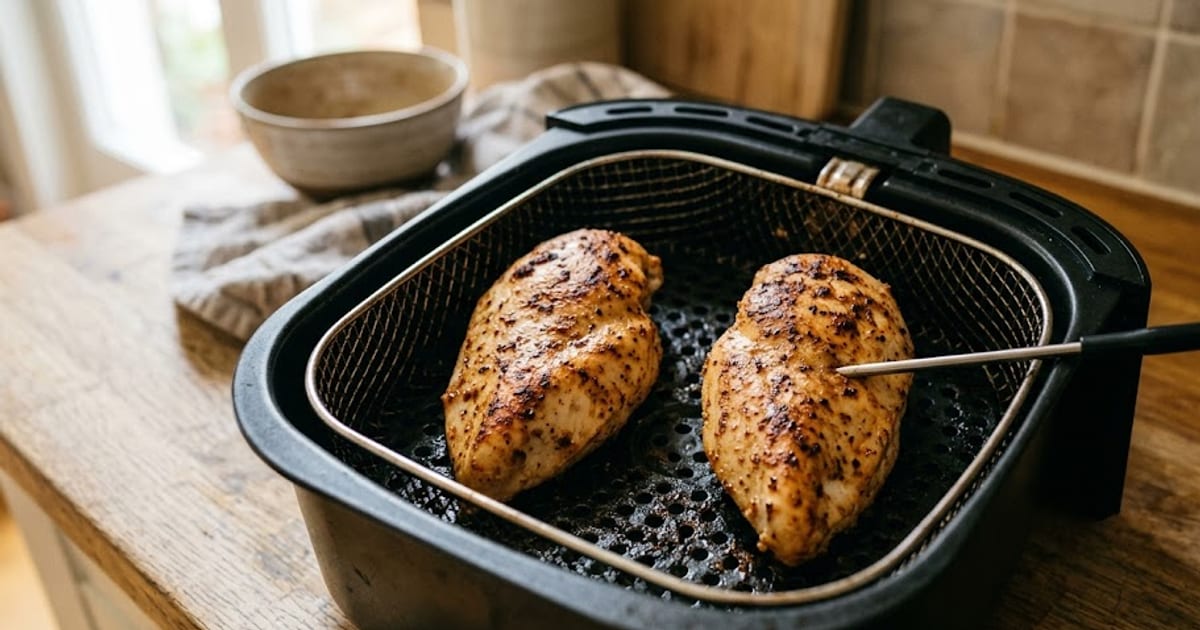
16 to 20 minutes at 375°F, flipped once at the halfway point, for a boneless breast of 6 to 8 oz. Pull at 160°F.
By weight
| Breast weight | 375°F | 400°F |
|---|---|---|
| 5 oz | 13–15 min | 11–13 min |
| 6–8 oz | 16–20 min | 14–17 min |
| 9–10 oz | 21–24 min | 18–21 min |
| Pounded to ¾ in | 12–14 min | 10–12 min |
| Frozen, from solid | 28–32 min | — |
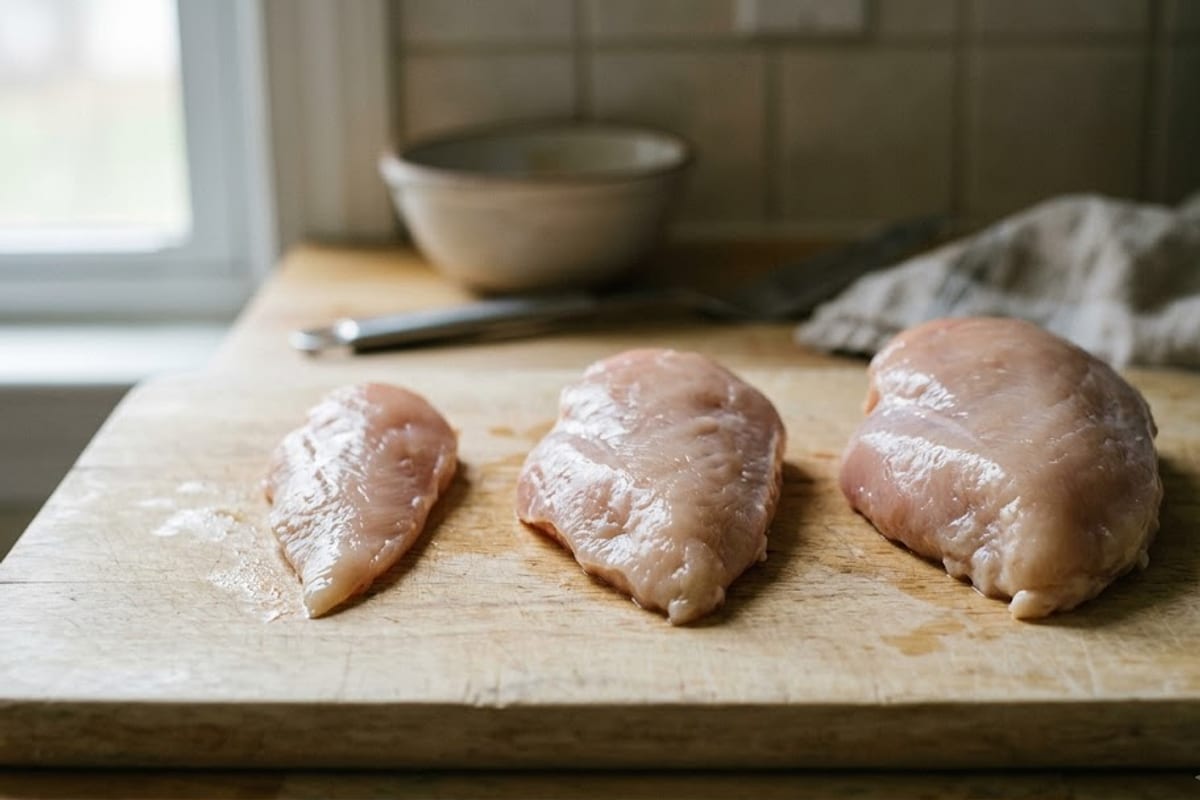
Why 375, when everything else wants 400
Air fryers cook by moving air fast across the surface. That is excellent for anything you want crisp and hard on anything you want juicy, because the surface dries long before the centre is ready.
Chicken thighs and wings tolerate 400°F because fat renders and protects them. A lean breast at 400°F gets a dry outer layer while the middle is still climbing — the same problem as a too-hot oven, made worse by the airflow.
At 375°F the gap narrows. On a thin, pounded breast, 400°F is fine because the centre arrives before the surface has time to dry.
The flip is not optional
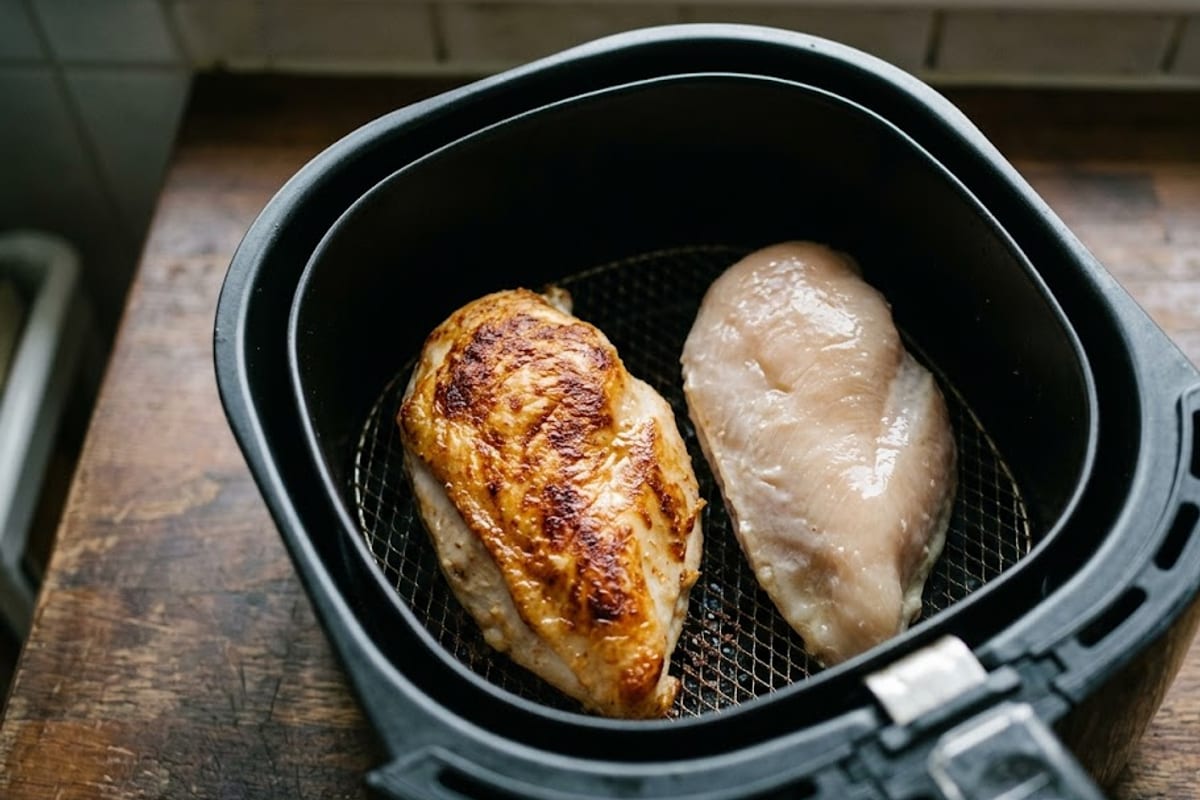
The basket floor is the hottest surface in the machine. A breast left on one side cooks unevenly enough to show up as a pale, wet top and a browned underside.
One flip at halfway is enough. More than that costs heat every time the drawer opens, and an air fryer recovers temperature slowly for its size.
Frozen, without thawing
Air fryers handle frozen chicken breast better than ovens do, because the moving air keeps the surface from sitting in the melt water.
Start at 360°F for the first 15 minutes, then raise to 375°F for the remainder — roughly 28 to 32 minutes total. Going straight to 375 browns the outside before the middle has thawed, and the probe reading in the centre will still be under 100°F when the surface looks finished.
Never air-fry frozen chicken that has been breaded at home; the coating comes off in the airflow.
Coating changes both time and temperature
A dry-rubbed breast follows the times above. Anything with a coating does not.
Breadcrumb or panko coating needs a light spray of oil to brown at all — dry crumb in moving air goes pale and dusty rather than golden. Add 2 to 3 minutes and drop to 360°F, because the crumb burns before the meat is ready at 375.
A wet batter does not work in an air fryer. There is no hot oil to set it, so it runs off the meat and onto the drawer. Recipes calling for batter in an air fryer are describing a dredge, not a batter.
A glaze or barbecue sauce goes on for the last 3 minutes only. Sugar burns quickly at these temperatures, and a breast sauced at the start comes out black at the edges.
Preheating is worth the three minutes
A cold start adds 3 to 4 minutes and, more importantly, changes the texture — the surface spends those minutes warming rather than searing, and the result is closer to baked than fried.
Some manuals say preheating is unnecessary. The times on this page assume 3 minutes of it.
Space, not time, is the variable people get wrong
Two breasts with a gap between them cook in the times above. Two breasts touching add 3 to 5 minutes and stay pale where they meet. Three crowded into a small basket will not finish evenly at any time setting.
If they do not fit in one layer with gaps, cook two batches. The second batch goes into a preheated machine and takes slightly less time than the first.
The target itself is the same as any other method — 165°F is the safe number and 160 is where to pull — and the oven version of this cut runs on exactly the same margin.