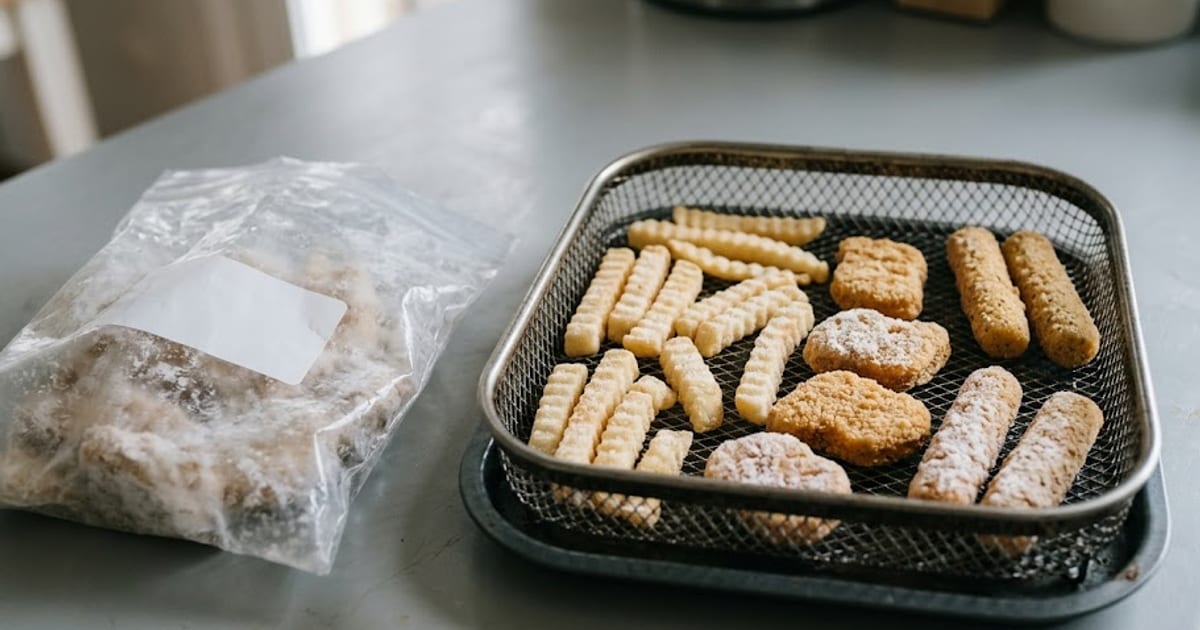
An air fryer is a small convection oven with a strong fan. Frozen food suits it particularly well, because the high airflow drives off surface ice and moisture quickly enough to brown rather than steam.
Do not thaw first. Thawing releases water into the coating and produces a soggy result.
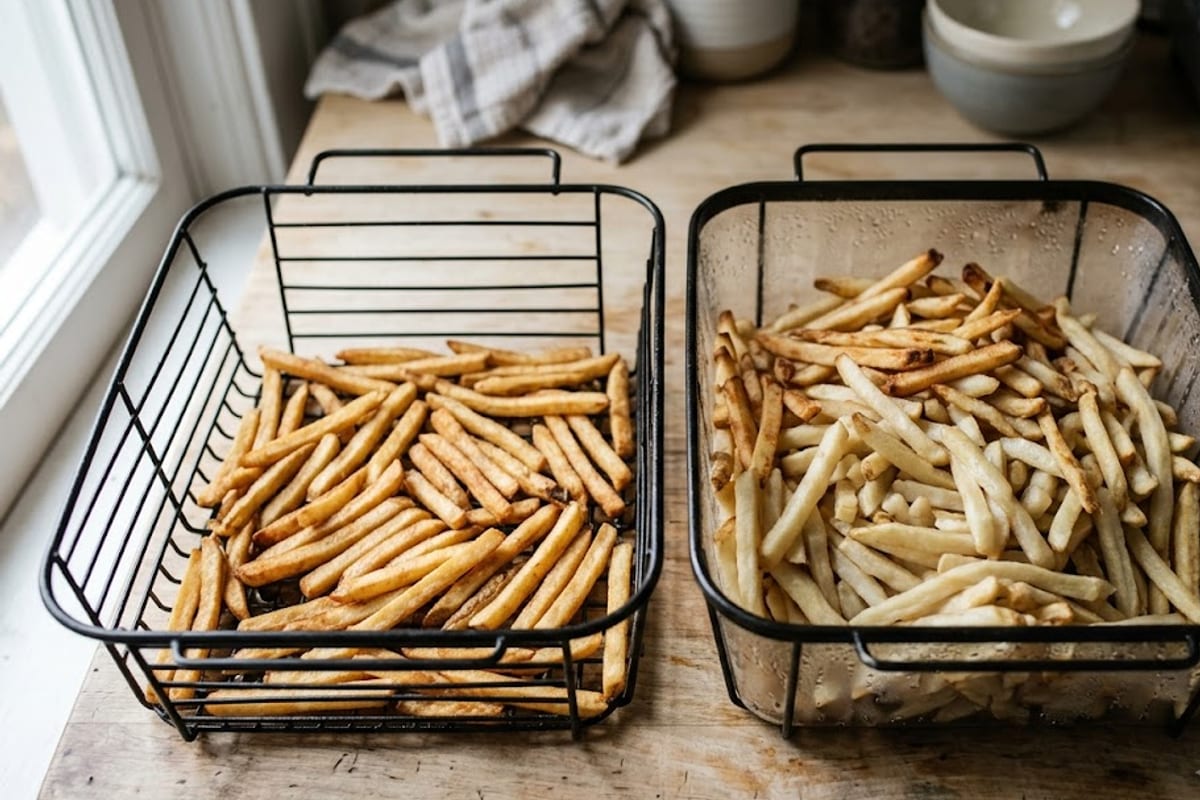
Times at 400°F, single layer
| Item | Time | Shake |
|---|---|---|
| French fries | 15–20 min | at 8 min |
| Sweet potato fries | 15–18 min | at 8 min |
| Tater tots | 12–16 min | at 7 min |
| Onion rings | 8–12 min | at 5 min |
| Mozzarella sticks | 6–8 min | once |
| Chicken nuggets | 10–12 min | at 6 min |
| Chicken tenders | 12–16 min | at 7 min |
| Fish fingers | 10–12 min | once |
| Spring rolls | 10–14 min | at 6 min |
| Pizza rolls | 6–8 min | at 4 min |
At 375°F for items that brown too fast — anything breaded and thin, or anything with sugar in the coating.
Loading is the whole game
A single layer with visible gaps. Two layers cooks the top and steams the bottom, and shaking does not fix it because the total mass is still blocking airflow.
Cooking in two batches takes longer in wall-clock terms and produces a result that is actually crisp. A full basket produces a larger quantity of something disappointing.
The basket's stated capacity is a volume, not a recommendation.
Preheat, briefly
Three to five minutes at temperature. It matters more for frozen food than for fresh, because the first job is driving surface ice off, and a cold appliance spends the first minutes doing that slowly while the food thaws.
Some machines preheat automatically; many do not, and the manual usually says which.
Shaking
Once for short cooks, twice for anything over 15 minutes. Shake rather than stir — the point is to change which surfaces face the airflow, not to redistribute evenly.
Items that sit flat and brown on one side, like fish fingers, are better turned than shaken.
Oil
Most frozen items already carry enough. A light spray helps colour on items that look dry — plain potato products, some vegetable items — and is unnecessary on anything battered.
Use a pump sprayer rather than aerosol cooking spray. Aerosol propellants damage the non-stick coating on many baskets, and manufacturers say so in the manual.
Converting oven instructions
The rule of thumb is to reduce the oven temperature by 25°F and cut the time by about 20%, then check early. An air fryer's airflow is more aggressive than a domestic fan oven's, so the first attempt at any item should be checked before the calculated time.
Write the result on the box. After one attempt, that item is solved permanently, and it is faster than looking it up again.
Food safety still applies
Frozen chicken and fish products need to reach the same internal temperatures as they would in an oven — 165°F for poultry. Browning quickly on the outside is exactly the situation where an undercooked centre is possible.
For anything raw-frozen rather than pre-cooked, use a thermometer rather than the colour.
Model differences are real
Basket machines and oven-style machines behave differently, and small baskets brown faster than large ones because the food sits closer to the element. Wattage varies widely across the category too.
The consequence is that any published time is a starting point rather than a setting. Check at two thirds of the stated time on the first attempt with a new item, and note what actually worked.
Things that do not work well
Wet batters run through the basket before they set. Frozen battered items are fine because the coating is already set; a home-battered item is not.
Very light items — a single tortilla, loose leaves — get blown into the element by the fan. Weigh them down or skip the appliance.
Large quantities of anything. This is the same crowding point, and it is the single most common reason people conclude the appliance is disappointing. An air fryer is a device for cooking a modest amount of something well, and asking it to feed six in one go is asking the wrong appliance.