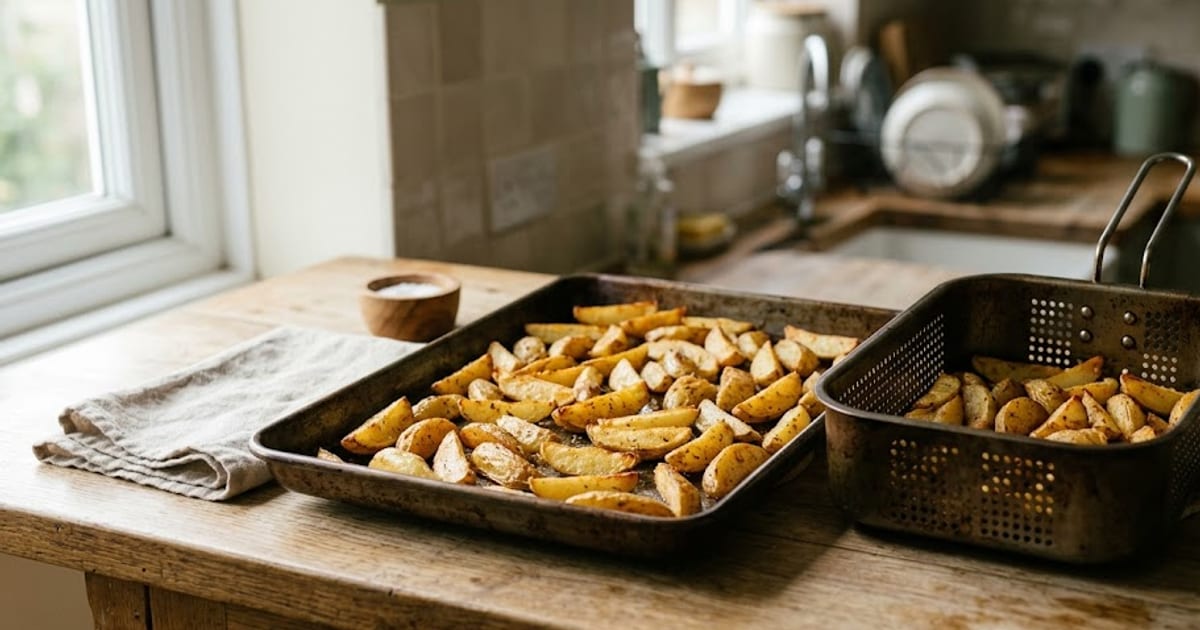
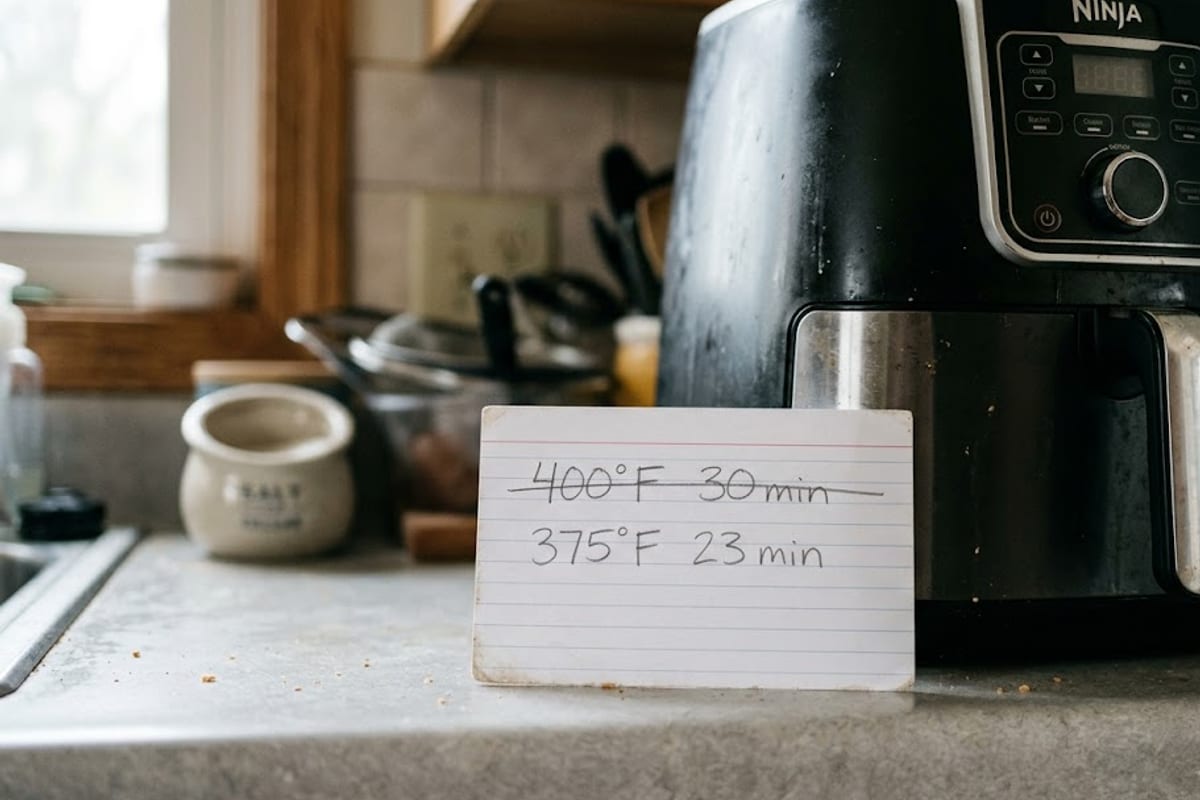
Lower the temperature by 25°F and cut the time by 20 to 25%. That converts most oven recipes to an air fryer, and then you check with a probe rather than trusting the arithmetic.
| Oven | Air fryer | Oven 30 min becomes |
|---|---|---|
| 325°F | 300°F | 23–24 min |
| 350°F | 325°F | 23–24 min |
| 375°F | 350°F | 23–24 min |
| 400°F | 375°F | 23–24 min |
| 425°F | 400°F | 23–24 min |
| 450°F | 425°F | 23–24 min |
Why the adjustment exists
An air fryer is a small convection oven with a disproportionately fast fan. Moving air strips away the thin insulating layer of still air that normally sits against food, so heat transfers faster at the same air temperature.
The result is that the food surface behaves as if it were in a hotter oven. Lowering the dial 25°F compensates for that; cutting the time accounts for the smaller cavity coming to temperature quickly and the food being closer to the element.
This is the same adjustment used for a conventional fan oven, just applied more aggressively — a fan oven is usually 25°F lower with a 10% time cut, an air fryer 25°F lower with a 20 to 25% cut.
Check early, always
The conversion is an estimate that gets you into range. Air fryer dials are less accurate than oven dials, there is no standard basket geometry, and two machines of the same capacity can differ by 25°F at the food surface.
Start checking at 60% of the converted time. On a converted 24-minute cook, that is 14 minutes. Nothing is lost by looking early and a great deal is lost by looking late, because an air fryer's small mass means it overshoots quickly.
Five recipes the rule does not convert
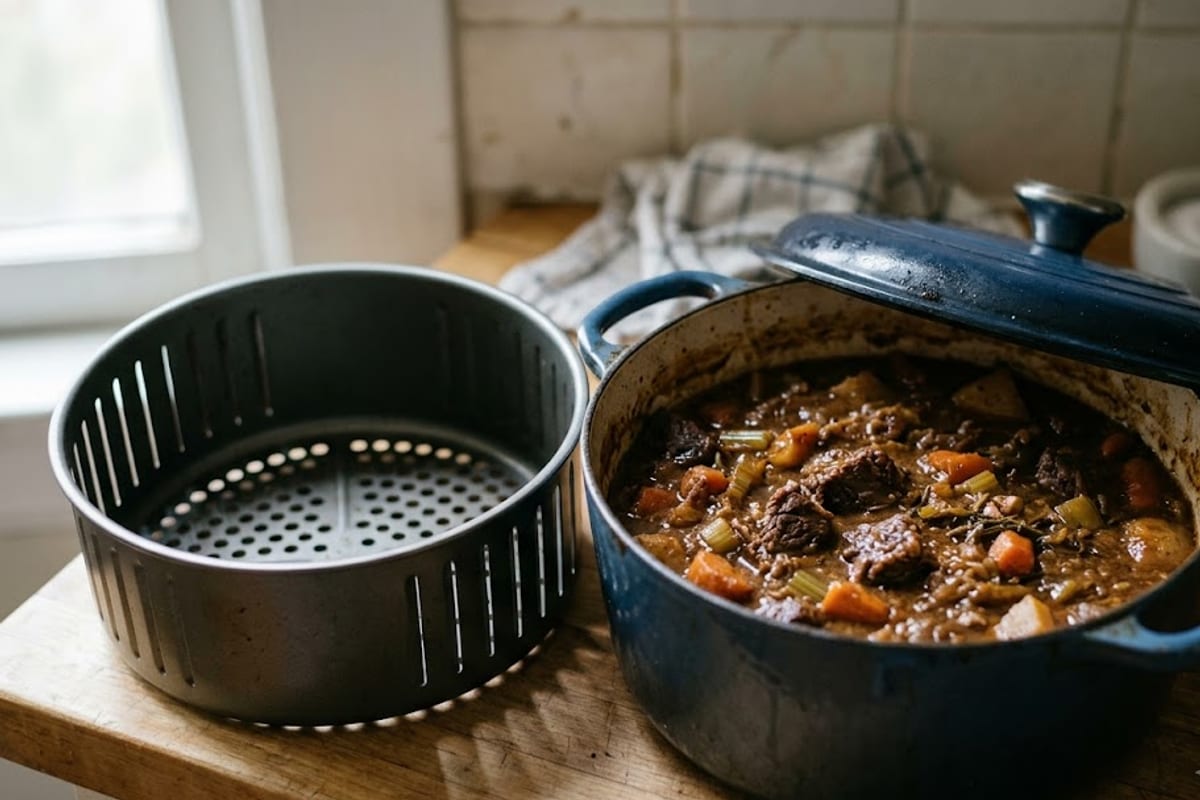
1. Anything with liquid in the pan. Braises, casseroles with sauce, anything cooked in stock. The basket is perforated and the drawer is not a cooking vessel. There is nothing to convert.
2. Wet batters. Beer batter, tempura, anything that relies on hot oil to set on contact. In moving air it runs off the food and onto the drawer floor. A recipe promising battered food in an air fryer means a dredge in flour or crumb, which is a different thing.
3. Large roasts and whole birds over about 4 lb. They do not fit in one layer, and one layer is the entire mechanism. A basket crammed with a roast is a small, badly ventilated oven.
4. Anything that rises before it sets. Soufflés, delicate cakes, choux. The airflow is strong enough to lopside them, and in a small basket the top is very close to the element.
5. Bakes where the top and the middle finish together. Lasagna, gratins, deep casseroles. Air fryers brown the surface hard and fast; a deep dish will have a dark top and a cold centre.
Where the conversion works better than the original
Frozen convenience food, unambiguously. It was engineered for hot dry air, the surface is already dry, and an air fryer does in 15 minutes what an oven does in 25 with a better texture.
Anything you want crisp in a single layer — wings, chips, roasted vegetables, breaded cutlets. The fast air is doing exactly what it is good at.
Reheating. Pizza, fried chicken and pastry come back far closer to their original texture than a microwave manages, and faster than an oven.
What does not change at all
The internal temperature targets. Poultry still reaches 165°F, ground meat 160°F, whole cuts 145°F with a rest. Airflow changes how quickly food gets there, not where "there" is.
Carryover does change: small pieces in fast air gain only 2 to 4°F after coming out, against 5 to 10°F for an oven roast. Pull and serving temperatures sit closer together here, which is one more reason to check early.
Specific times are on the full chart, and the oven side of any conversion follows its own predictable relationship with temperature.