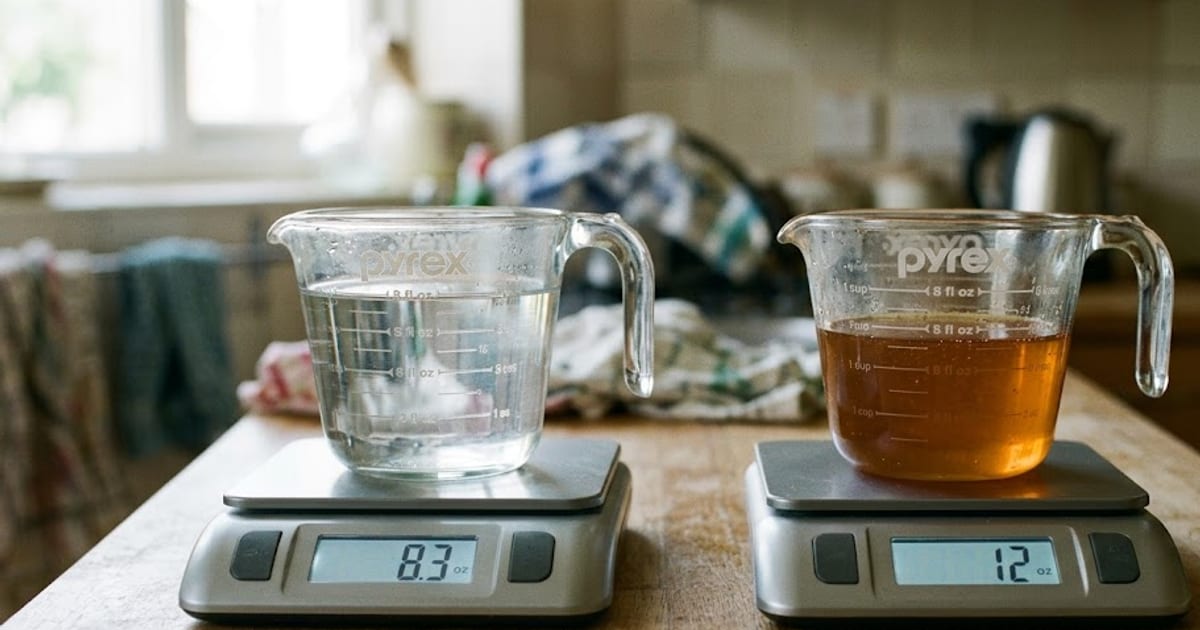
8 fluid ounces in a US cup. Always, for anything — it is a measure of volume, and volume does not care what is in the cup.
| Fluid ounces | mL | |
|---|---|---|
| 1 cup | 8 | 237 |
| ¾ cup | 6 | 177 |
| ⅔ cup | 5.3 | 158 |
| ½ cup | 4 | 118 |
| ⅓ cup | 2.7 | 79 |
| ¼ cup | 2 | 59 |
| 1 tablespoon | 0.5 | 14.8 |
| 1 teaspoon | 0.17 | 4.9 |
The trap: two different ounces
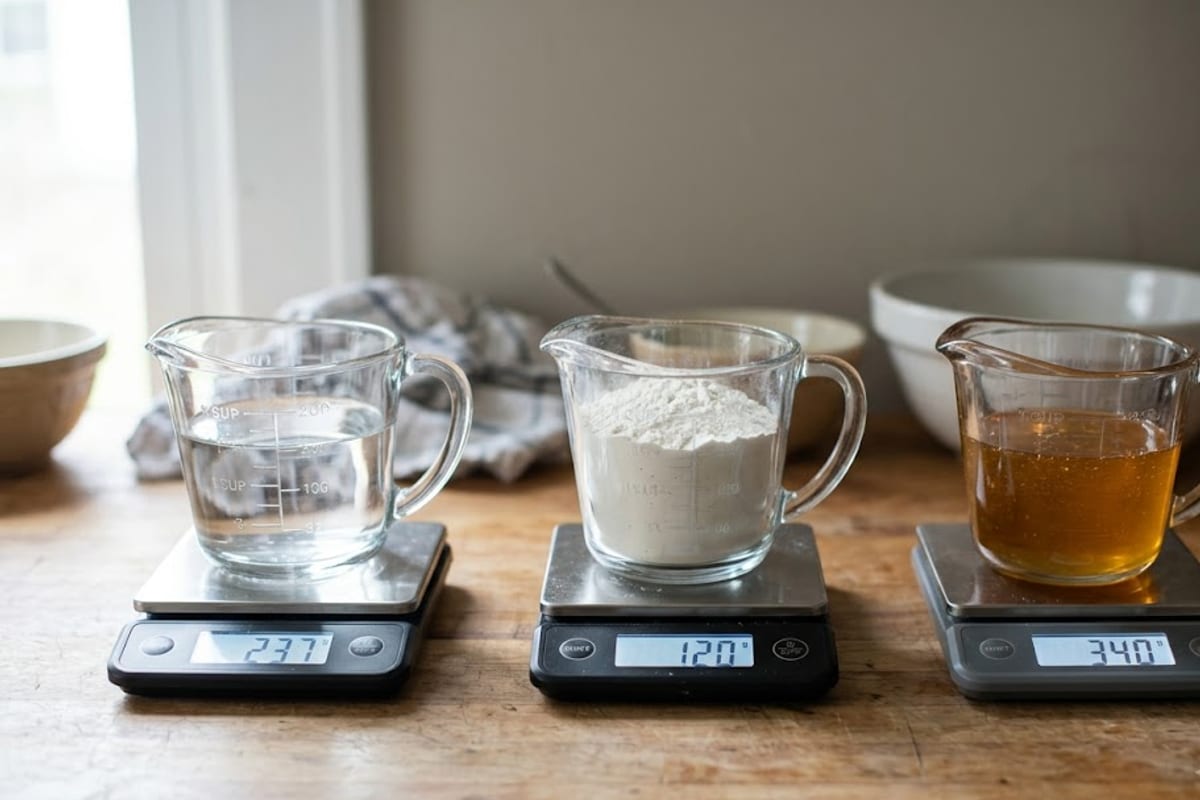
A fluid ounce measures volume. An ounce measures weight. They share a name and they are not the same quantity.
A cup of water happens to be both 8 fluid ounces and 8 ounces of weight, because water weighs almost exactly a gram per millilitre. That coincidence is convenient and it is the source of nearly every measuring error in a home kitchen, because it does not hold for anything else.
| One cup of | Fluid oz | Weight (oz) | Weight (g) |
|---|---|---|---|
| Water | 8 | 8.0 | 237 |
| Milk | 8 | 8.6 | 245 |
| All-purpose flour | 8 | 4.25 | 120 |
| Granulated sugar | 8 | 7.1 | 200 |
| Brown sugar, packed | 8 | 7.5 | 213 |
| Butter | 8 | 8.0 | 227 |
| Rolled oats | 8 | 3.2 | 90 |
| Cocoa powder | 8 | 3.0 | 85 |
| Honey | 8 | 12.0 | 340 |
A cup of honey weighs nearly four times what a cup of oats weighs. Both are one cup.
Which one a recipe means
The convention is reliable enough to use:
Dry ingredients given in ounces mean weight. "8 oz flour" is 8 ounces on a scale — about 1⅞ cups, not one cup.
Liquids given in ounces mean fluid ounces. "8 oz milk" is one cup.
Anything given in grams means weight, without ambiguity, which is why grams are the better unit and why every serious modern recipe includes them.
British and Australian recipes are more likely to give everything by weight, including liquids, which removes the question entirely.
Butter, and why it is the easy one
Butter is sold in sticks with the measurements printed on the wrapper, and it is the one ingredient where cups, ounces and tablespoons all line up:
| 1 stick | ½ cup = 4 oz = 8 tbsp = 113 g |
| 2 sticks | 1 cup = 8 oz = 16 tbsp = 227 g |
| 4 sticks | 1 lb = 2 cups = 454 g |
That works because butter is sold pre-portioned rather than measured by the cook, which is exactly the reason it is accurate and everything else is not.
Dry cups and liquid cups
They hold the same volume. The difference is how they are read: a liquid cup has headroom and a spout so it can be filled to a line and read at eye level; a dry cup is filled to the brim and levelled with a straight edge.
Using a liquid cup for flour makes levelling impossible. Using a dry cup for milk means filling it to the very brim and carrying it without spilling. Both work; both are awkward in the wrong direction.
The real accuracy problem is not the cup at all. It is that powders compress and liquids do not — the same cup of flour varies by 25% depending on how it was filled, and no conversion table can see that.
For the larger volumes, the gallon ladder is all halves.