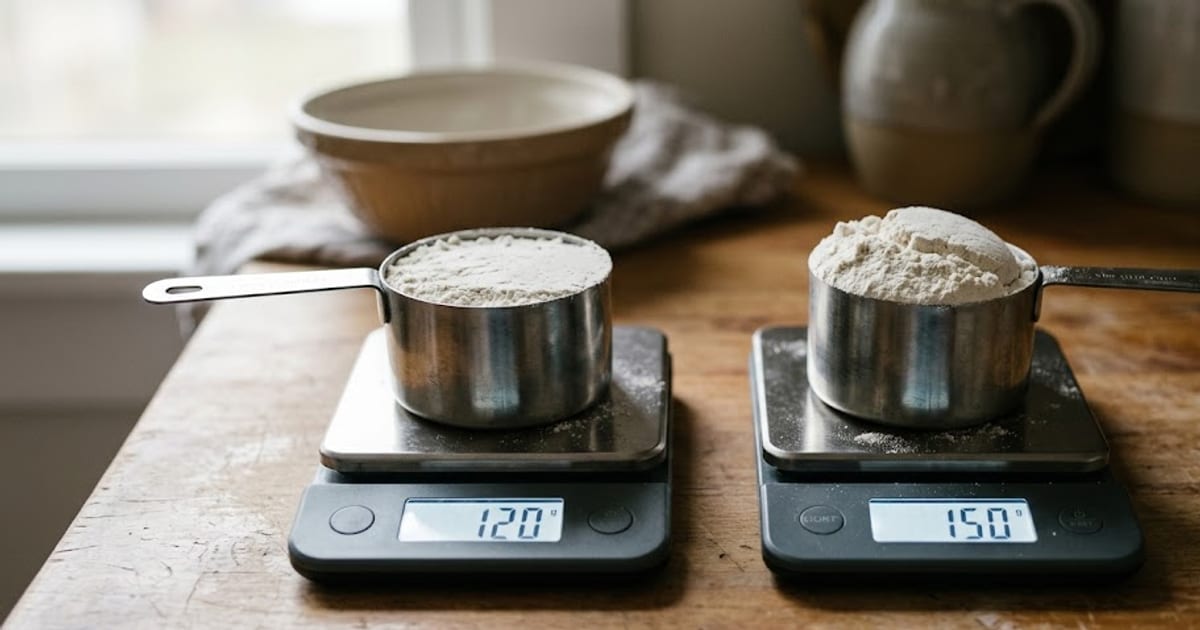
A pound of all-purpose flour is 3 to 3¾ cups. Not one number, and the spread is not sloppiness — it is the honest range produced by how the cup gets filled.
| How the cup is filled | Grams per cup | Cups per pound |
|---|---|---|
| Spooned in, levelled off | 120 g | 3¾ cups |
| Spooned, lightly settled | 125 g | 3⅔ cups |
| Scooped from the bag | 140 g | 3¼ cups |
| Scooped and packed | 150 g | 3 cups |
Same cup, same flour, 25% difference between the top row and the bottom.
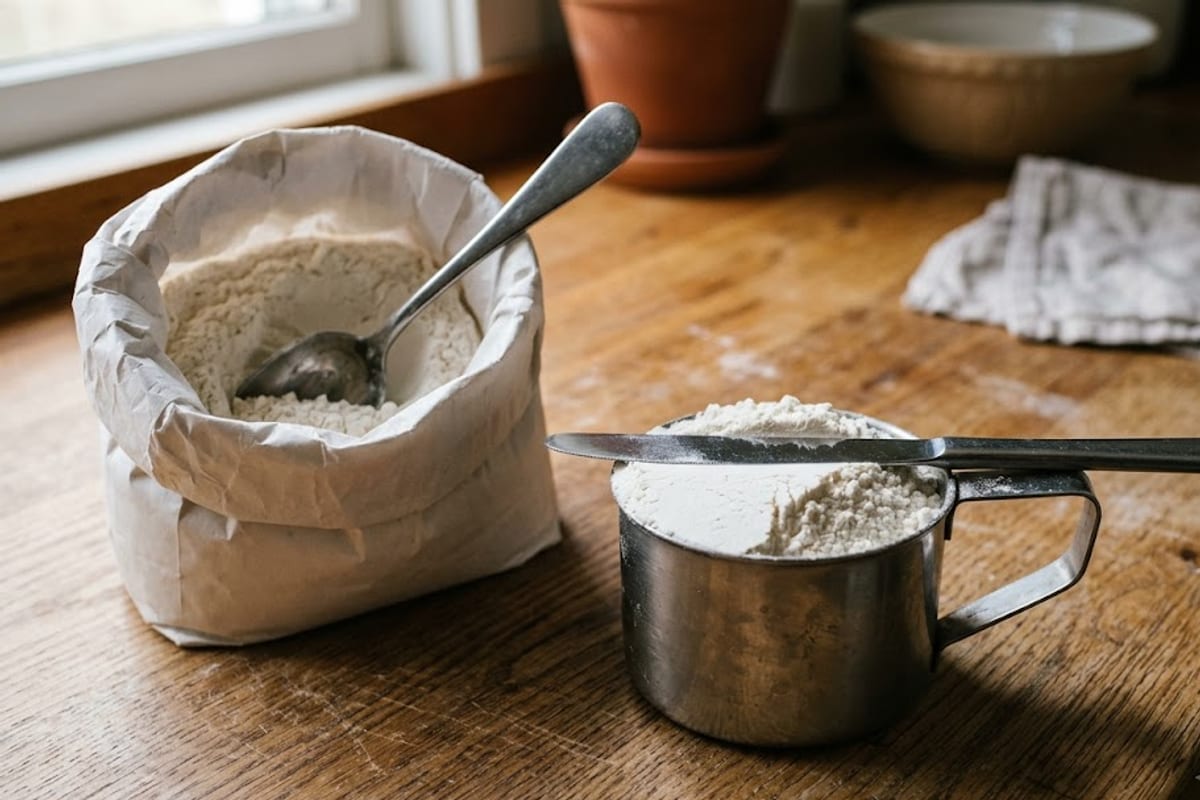
Dip the cup into the bag and you compress the flour on the way in. Spoon it in loosely and level the top with a straight edge and you do not. Every recipe was written by someone doing one of these and almost none of them say which.
Which number a recipe means
American recipes generally assume 120 to 125 g per cup — spooned and levelled. King Arthur standardised on 120 g, and most modern US recipe sites follow.
Older cookbooks and many home recipes assume scooping, closer to 140 g, because that is what people actually did before scales were common in home kitchens.
If a recipe gives grams alongside cups, the grams tell you which convention it used. If a bread recipe comes out dry and dense, there is a fair chance you scooped where the author spooned, and you are a quarter over on flour.
The rest of the baking shelf
| Ingredient | Grams per cup | Cups per pound (454 g) |
|---|---|---|
| All-purpose flour, spooned | 120 g | 3¾ |
| Bread flour | 120 g | 3¾ |
| Cake flour | 114 g | 4 |
| Whole wheat flour | 113 g | 4 |
| Granulated sugar | 200 g | 2¼ |
| Brown sugar, packed | 213 g | 2⅛ |
| Powdered sugar, sifted | 120 g | 3¾ |
| Butter | 227 g | 2 (4 sticks) |
| Water | 237 g | 1.9 |
| Rolled oats | 90 g | 5 |
| Cocoa powder | 85 g | 5⅓ |
Butter is the only one on this list that is genuinely exact, and only because it is sold in pre-portioned sticks with the marks printed on the wrapper. 1 lb butter = 2 cups = 4 sticks, every time.
Sugar behaves far better than flour because the crystals are hard and do not compress. Scooping granulated sugar changes the weight by 2 to 3%, not 25%.
Why flour is the worst case
Flour is a fine powder with a lot of air trapped between particles. That air is compressible, and everything you do to the cup — dipping, tapping, shaking level — squeezes some of it out.
Three things make it worse:
Humidity. Flour absorbs moisture from the air. The same cup weighs a few grams more in an August kitchen than a January one.
Settling. A bag that has sat in a cupboard for a month is denser at the bottom than the top. The first cup and the last cup out of the bag are not the same cup.
Sifting. Sifted flour is roughly 10 to 15% lighter by volume. "1 cup sifted flour" and "1 cup flour, sifted" mean different things — the first sifts before measuring, the second after — and they differ by about 15 g.
When it matters and when it does not
It matters in bread and pastry. These are ratio doughs: hydration is flour weight against water weight, and being 25% over on flour turns a 70% hydration dough into 56%. That is a visibly different loaf.
It matters less in cake and cookies, which carry enough fat and sugar to absorb the error, though a quarter-cup surplus still shows up as dry and cakey.
It barely matters in gravy, coatings and thickening, where you adjust by eye anyway.
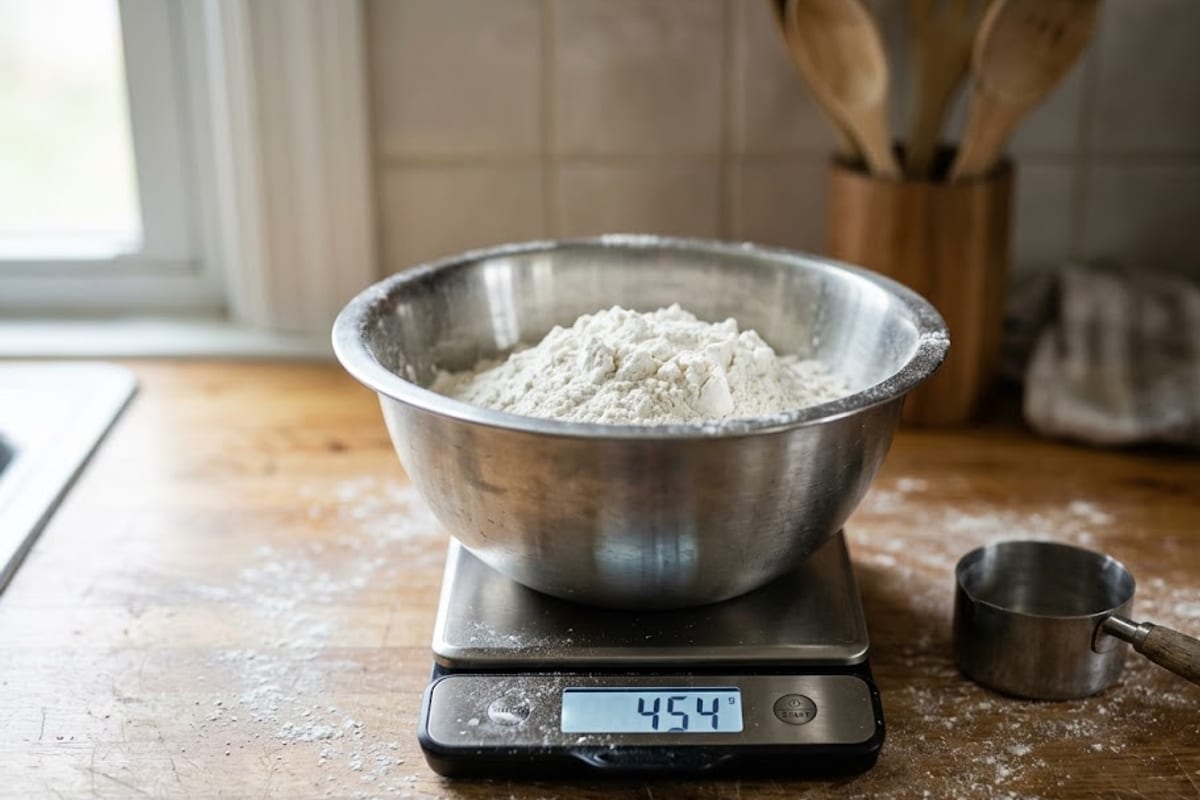
A $12 kitchen scale removes the variable entirely and is faster than washing three measuring cups. Weigh in grams, not ounces — the increments are ten times finer, and every serious recipe published in the last decade gives grams.
For everything cooked rather than baked, the number that decides the outcome is not on the scale but on the probe: see the doneness table and oven timing by weight.