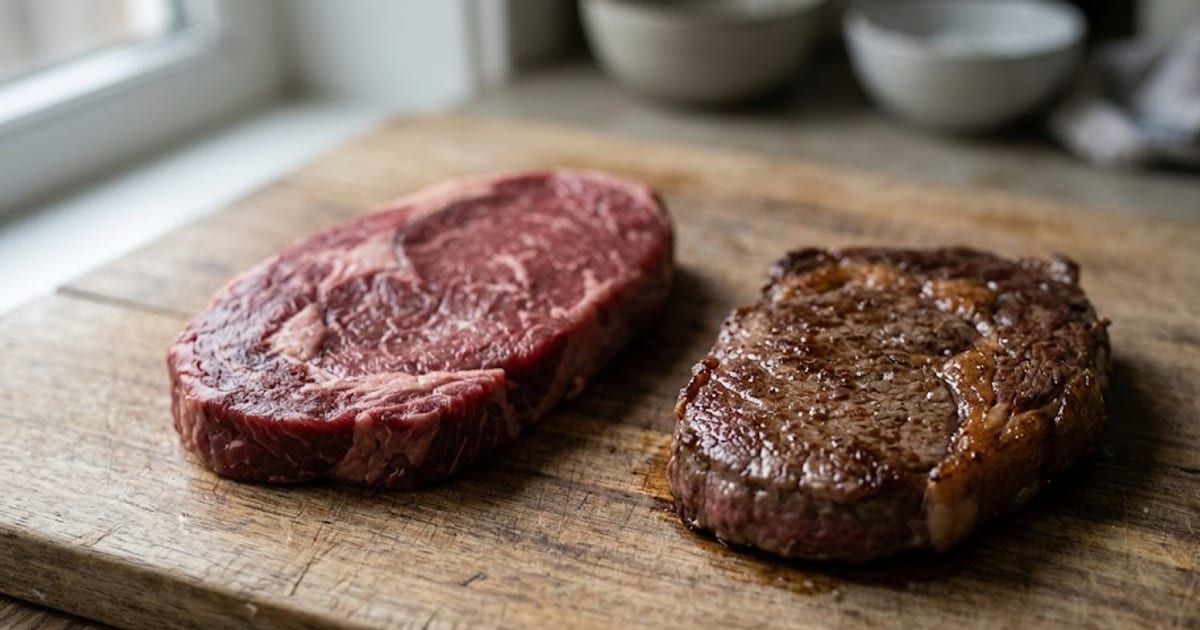
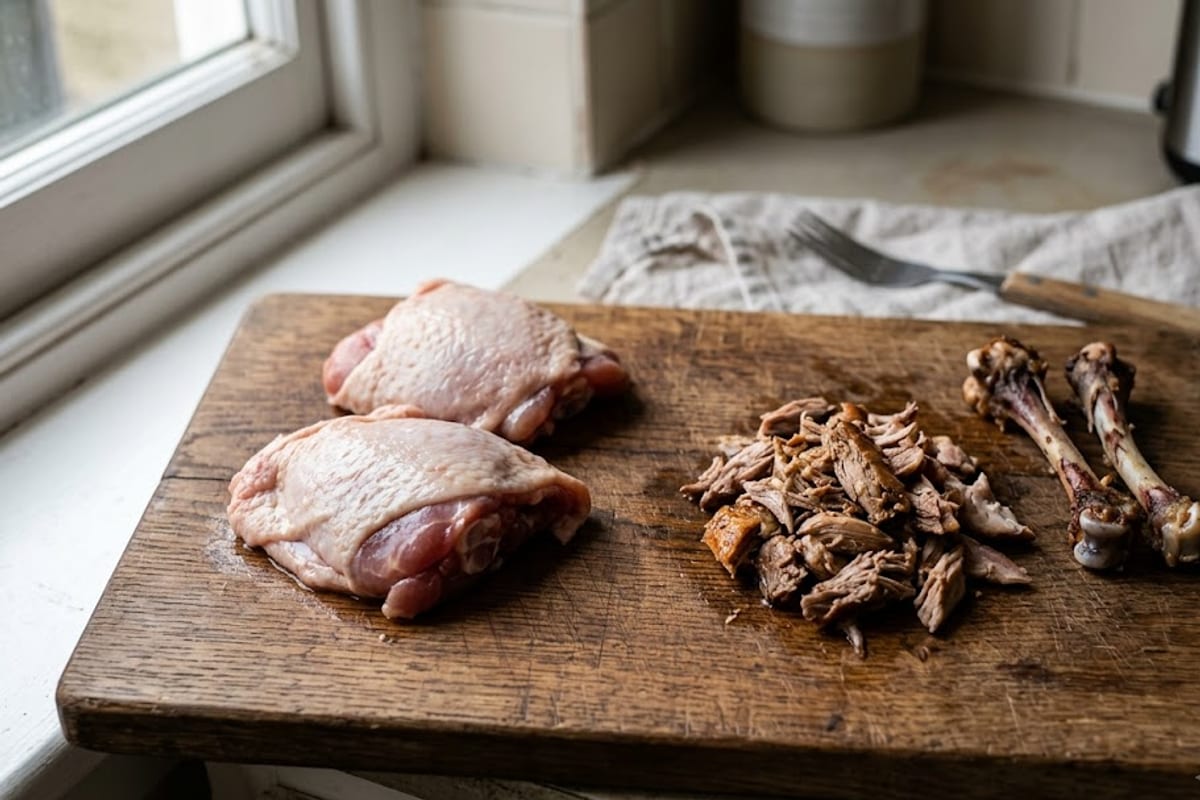
Two things reduce raw weight before it reaches a plate: bone and trim, which are removed, and shrinkage, which is water and fat lost during cooking.
Cooking loss runs roughly 20 to 30% for most cuts, more for anything cooked long or well done.
Buying quantities
Based on a 6 oz cooked portion for an adult main course:
| Raw weight per person | |
|---|---|
| Boneless steak, chops, fillets | 1/2 lb |
| Boneless roast | 1/2 to 2/3 lb |
| Bone-in chops or steak | 3/4 lb |
| Bone-in roast, rib of beef | 3/4 to 1 lb |
| Whole chicken | 1 to 1 1/4 lb |
| Whole turkey | 1 1/4 to 1 1/2 lb |
| Ribs | 1 to 1 1/2 lb |
| Ground meat | 1/3 to 1/2 lb |
| Whole fish | 3/4 to 1 lb |
| Fish fillet | 1/3 to 1/2 lb |
Ribs are the extreme case: a slab is mostly bone, which is why the figure looks so high against boneless cuts.
Adjust for who is eating
Add a third for a crowd of large appetites or where the meat is the whole meal. Reduce by a quarter where there are several substantial sides, which is why the turkey figure often produces more leftovers than expected — Thanksgiving has more side dishes than any other meal of the year.
Children under about twelve count as roughly half an adult portion, and teenagers frequently count as more than one.
Deliberate leftovers
If leftovers are the plan, add rather than adjusting the per-person figure — decide how many extra meals you want and add that many portions.
A turkey bought at 1 1/2 lb per person for a group of eight is a 12 lb bird, and it will produce several meals afterwards. That is a purchase decision rather than an accident, and it is worth making deliberately because the difference between 12 lb and 16 lb is an hour of cooking time.
Whole birds, specifically
A whole chicken yields roughly 50 to 55% edible meat against its raw weight. A turkey is similar. That is why the per-person figure for a whole bird is roughly double the boneless figure.
Larger birds yield slightly better than small ones, because the frame is proportionally smaller. Two 6 lb chickens give less meat than one 12 lb turkey, and they cook faster and more evenly, which is the trade.
Cooking method changes the yield
Low and slow loses less moisture proportionally than high heat, so a braised or smoked cut yields better than the same cut roasted hot.
Well done loses considerably more than medium rare. A group that wants everything well done needs more raw weight than the table suggests.
Brining reduces net loss by a few percent, which is a real effect on a large bird and negligible on a steak.
The practical approach
Round up. Running out is a problem at the table; leftovers are not. On anything bone-in, add a quarter to the calculated figure and stop worrying about it.
Buffet and mixed service
Where several proteins are served together, total meat per person can drop to roughly half a pound cooked across all of them, because people take some of each rather than a full portion of one.
The arithmetic that works is to decide total cooked meat per person first, then divide it among the proteins by how popular each is likely to be. Calculating a full portion of each and adding them together buys far more than anyone eats.
Ordering from a butcher
Ask for the finished weight you want rather than the raw weight. A butcher knows the yield on the cut and will supply accordingly, and it removes the bone and trim arithmetic entirely.
For a bone-in roast, specify the number of people and the number of bones together — a rib of beef is sold by bone count, and the useful figure is roughly two people per bone.
Freezing what is left
Meat freezes well and cooked meat freezes less well than raw, so where a large purchase is being split it is better to freeze the extra raw than to cook it all and freeze the remainder.
Portion before freezing rather than after. A single frozen block has to be thawed entirely to use any of it, and that is how leftovers become waste.