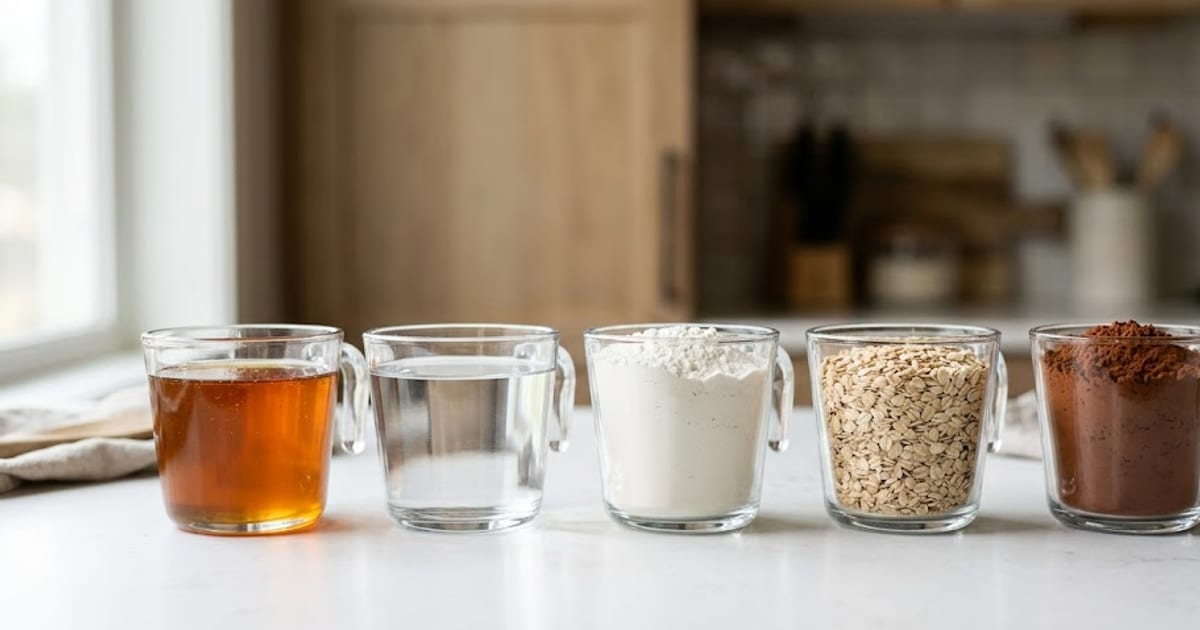
There is no single answer, because a cup measures volume and a gram measures weight. The number depends on what is in the cup.
| One cup of | Grams |
|---|---|
| Water | 237 |
| Milk | 245 |
| All-purpose flour, spooned & levelled | 120 |
| Bread flour | 120 |
| Cake flour | 114 |
| Whole wheat flour | 113 |
| Granulated sugar | 200 |
| Brown sugar, packed | 213 |
| Powdered sugar, sifted | 120 |
| Butter | 227 |
| Vegetable oil | 218 |
| Honey | 340 |
| Rolled oats | 90 |
| Cocoa powder | 85 |
| Rice, uncooked | 185 |
| Chocolate chips | 170 |
| Chopped nuts | 120 |
| Grated parmesan | 100 |
| Breadcrumbs, dry | 108 |
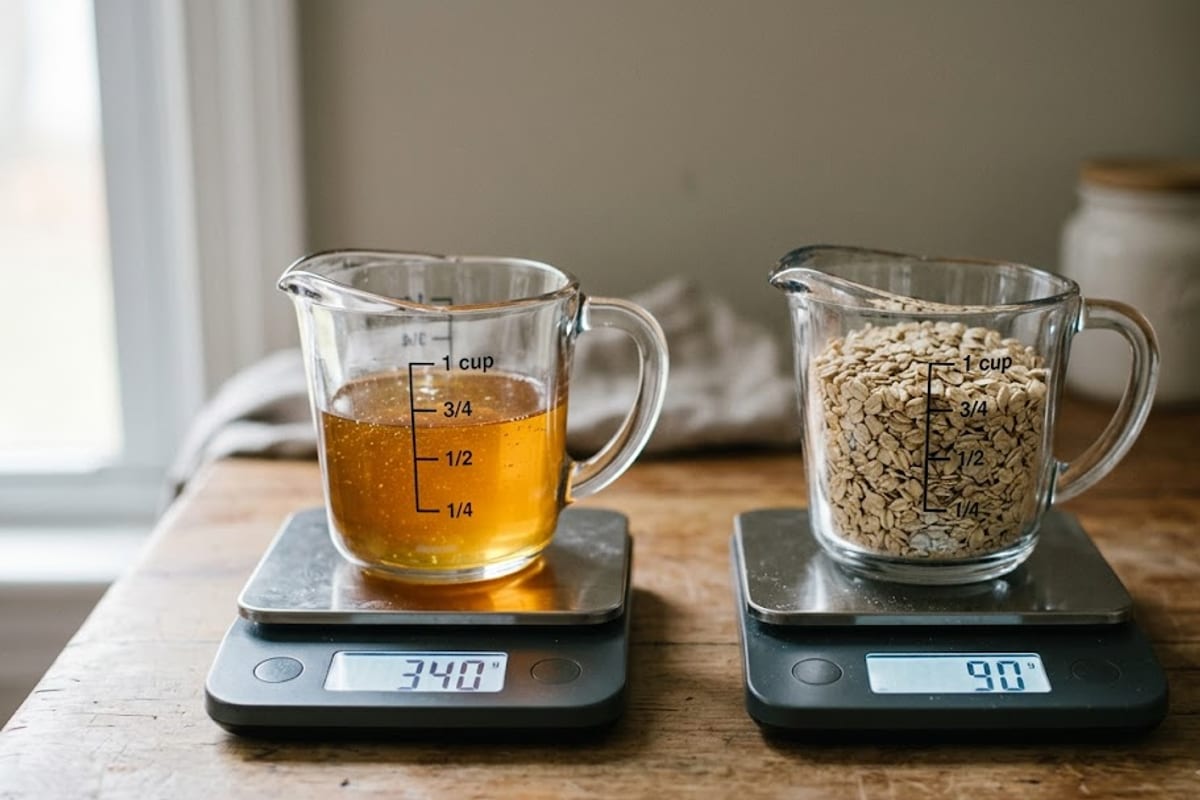
Honey is nearly four times the weight of rolled oats at the same volume. That range is why a recipe written in cups is a recipe with a built-in tolerance, and why a recipe written in grams is not.
Flour is the one that moves
Every figure above is fixed except flour, and flour is the ingredient that most decides whether a dough works.
| How the cup is filled | Grams |
|---|---|
| Spooned in, levelled | 120 |
| Spooned, lightly settled | 125 |
| Scooped from the bag | 140 |
| Scooped and packed | 150 |
That is a 25% spread on the same cup of the same flour. Sugar varies by 2 to 3% because the crystals are hard and do not compress; flour is a fine powder holding a great deal of squeezable air.
American recipes written in the last decade generally assume 120 to 125 g per cup. Older ones assume scooping, closer to 140. Almost none say which, and a bread that comes out dry and dense is often nothing more than that difference.
Converting a cup recipe to weights
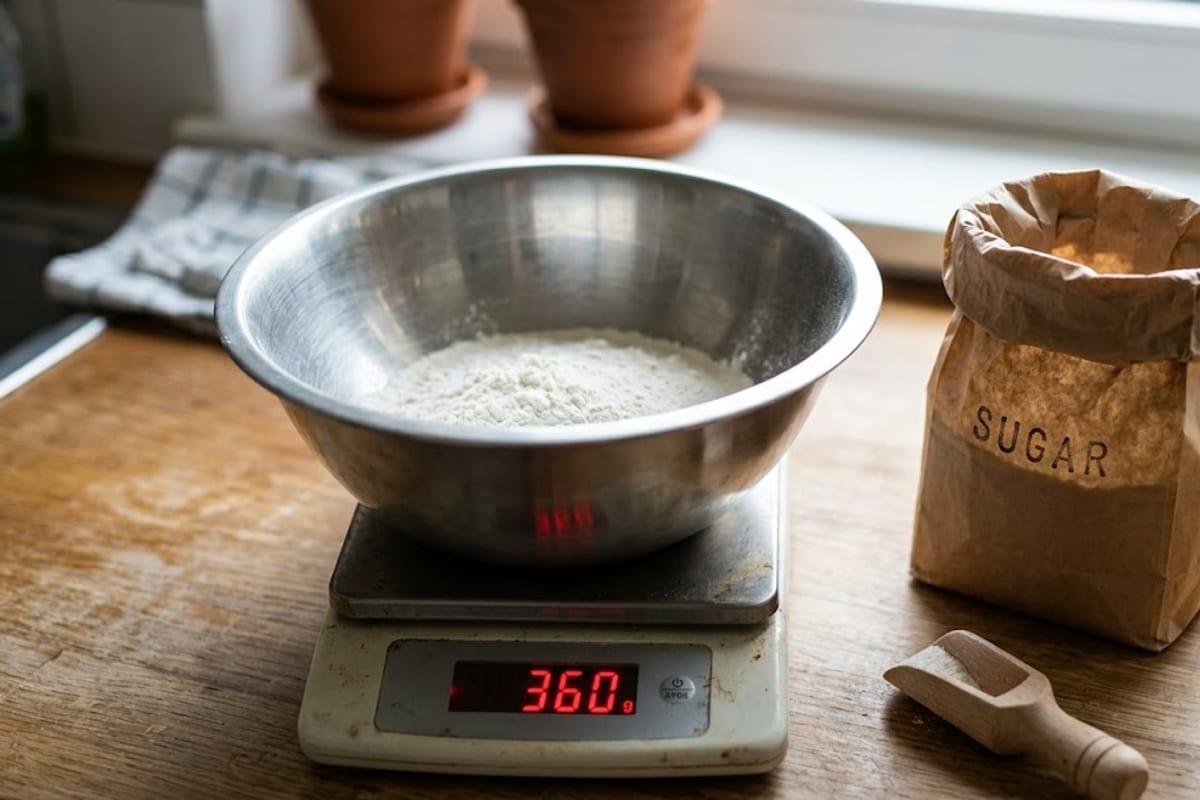
Work through the ingredient list once, replace each cup measure with the gram figure above, and write it in the margin. From then on that recipe is repeatable.
Two things make it easier than it sounds:
Weigh into the bowl cumulatively. Bowl on the scale, tare, add flour to 360 g, tare, add sugar to 200 g, tare, and so on. One bowl, no measuring cups, nothing to wash.
Liquids can stay in cups if you prefer. Water and milk do not vary with how they are poured, so there is nothing to gain — the accuracy problem is entirely with powders.
What a scale changes beyond accuracy
The accuracy is the stated reason and the smaller one. Three practical changes matter more day to day.
Fewer things to wash. A set of nested measuring cups and spoons is six or seven items per bake. A scale and one bowl is two.
Sticky ingredients stop being a problem. Honey, syrup, peanut butter and molasses all leave a measurable amount behind in a cup, and no amount of scraping recovers all of it. Weighed straight into the bowl, none of it is lost and there is nothing to scrape.
Scaling becomes arithmetic. Multiplying 360 g by 1.5 is trivial. Multiplying three cups by 1.5 gives four and a half cups, which is fine, but multiplying ⅔ cup by 1.5 gives a number you then have to translate back into spoons.
Why grams rather than ounces
The increments are ten times finer. An ounce is about 28 grams, so a scale reading in whole ounces cannot distinguish 120 g of flour from 133 g — a difference that matters.
Every serious modern recipe gives grams for that reason, and every kitchen scale sold has a gram mode.
The metric cup, which is a different cup
Australia and New Zealand use a 250 mL cup, against the US 237 mL. That is about 5% larger.
Five percent is invisible in a soup and visible in a cake. Where a recipe's origin is unclear and the quantities are large, the gram figures on this page are the safer route precisely because they carry no country with them.
The same divide runs through the fluid ounce and the tablespoon, where Australia's is a third larger than everyone else's.