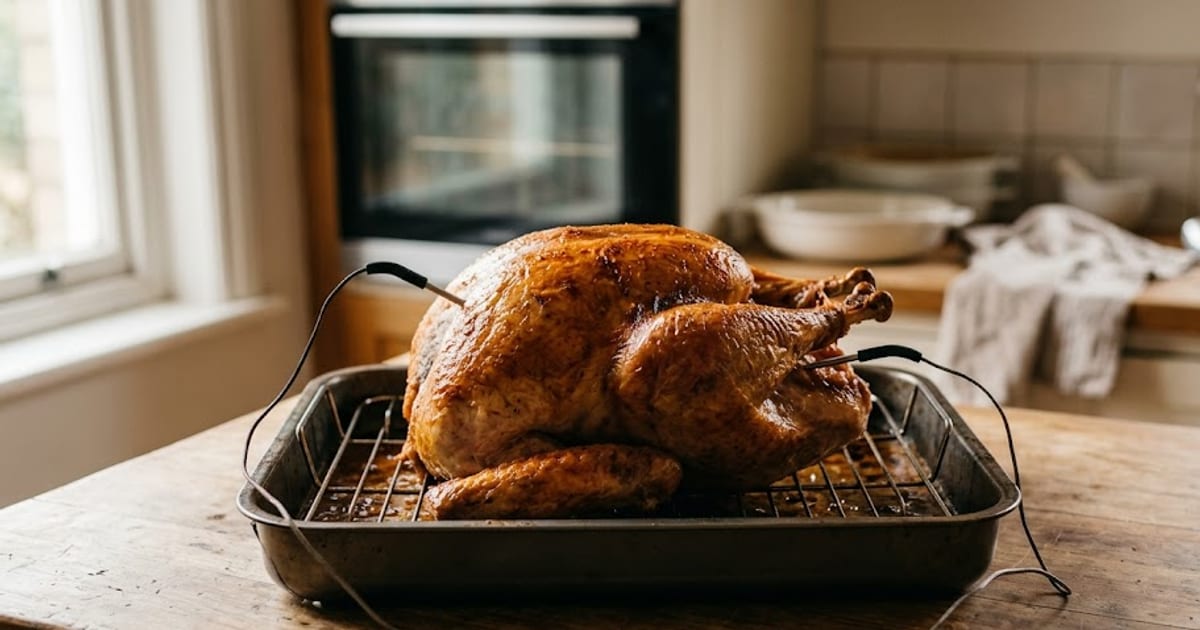
About 13 minutes per pound at 325°F, unstuffed. Add roughly 30 to 45 minutes if it is stuffed — not per pound, but in total.
| Weight | 325°F, unstuffed | 325°F, stuffed | 350°F, unstuffed |
|---|---|---|---|
| 8–10 lb | 1¾–2¼ h | 2¼–2¾ h | 1½–2 h |
| 10–14 lb | 2¼–3 h | 3–3½ h | 2–2½ h |
| 14–18 lb | 3–3¾ h | 3¾–4½ h | 2¾–3¼ h |
| 18–20 lb | 3¾–4¼ h | 4½–5 h | 3¼–3¾ h |
| 20–24 lb | 4¼–5 h | 5–5½ h | 3¾–4¼ h |
Per-pound rules break down at both ends. A small turkey takes proportionally longer per pound than a large one, because it has more surface for its mass; a very large one takes proportionally less. The table above already accounts for that, which the flat rule does not.
Two birds in one
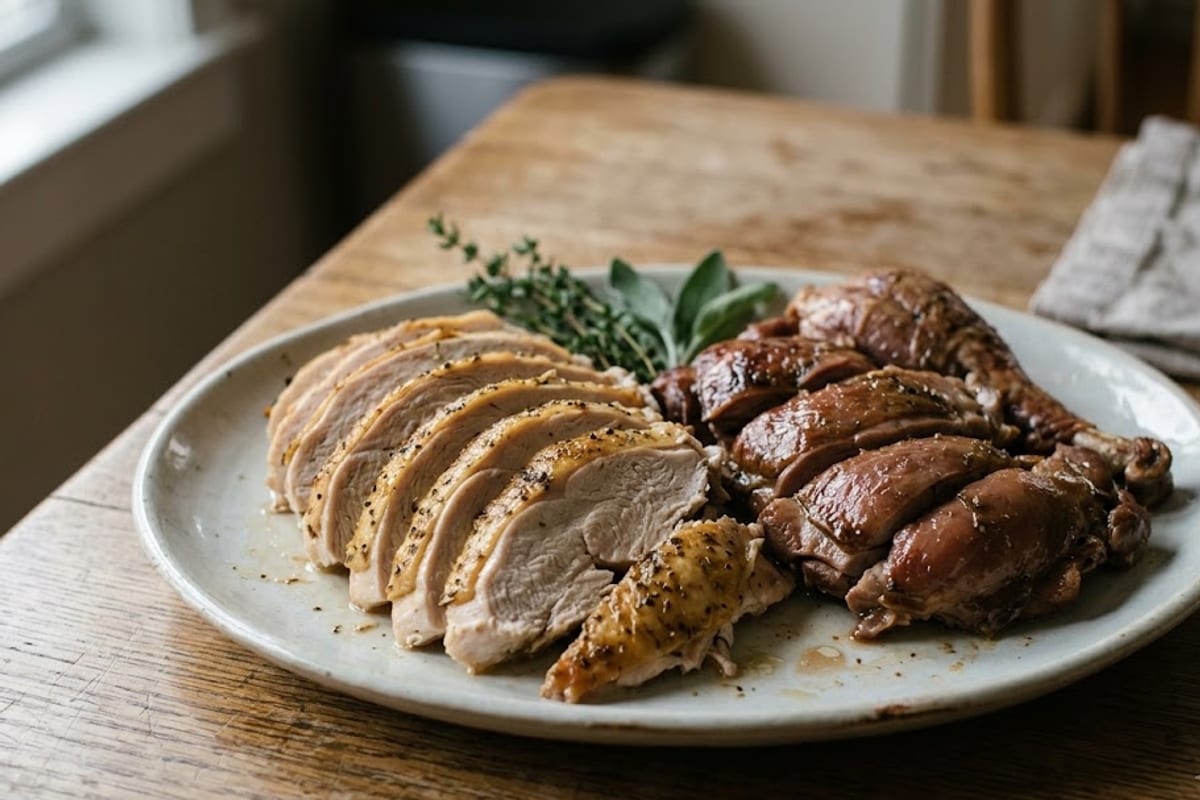
Breast is lean and dries past 165°F. Thigh is dark meat full of collagen and is unpleasant below about 175°F.
They are attached to each other, they sit at different depths, and the breast is on the outside facing the oven. Left to itself, a turkey reaches 165 in the breast a good half hour before the thigh reaches 175.
Three ways to close that gap, in order of how much difference they make:
Spatchcock it. Remove the backbone and flatten the bird. Everything cooks in one plane, the time drops to about 80 minutes for a 14 lb bird at 400°F, and breast and thigh finish within minutes of each other. It is the single largest improvement available and the only cost is that it does not look like a magazine cover.
Ice the breast before it goes in. Twenty minutes with a bag of ice on the breast lowers its starting temperature, so it lags the thigh instead of leading it.
Start breast side down, turn it after the first hour. Awkward with a hot heavy bird, but effective.
The two readings that matter
Thigh: into the thickest part, away from the bone. Bone reads high — often ten degrees — and that reading is exactly what sends an undercooked thigh to the table. Target 175°F.
Breast: into the thickest part from the side. Pull the bird when this reads 160°F, because carryover on a bird this size is 10 to 15°F.
Pop-up timers are set to trigger around 180°F in the breast, which is well past ruined. They are a convenience for people not using a thermometer, not a target.
Stuffing is the usual reason a turkey dries out
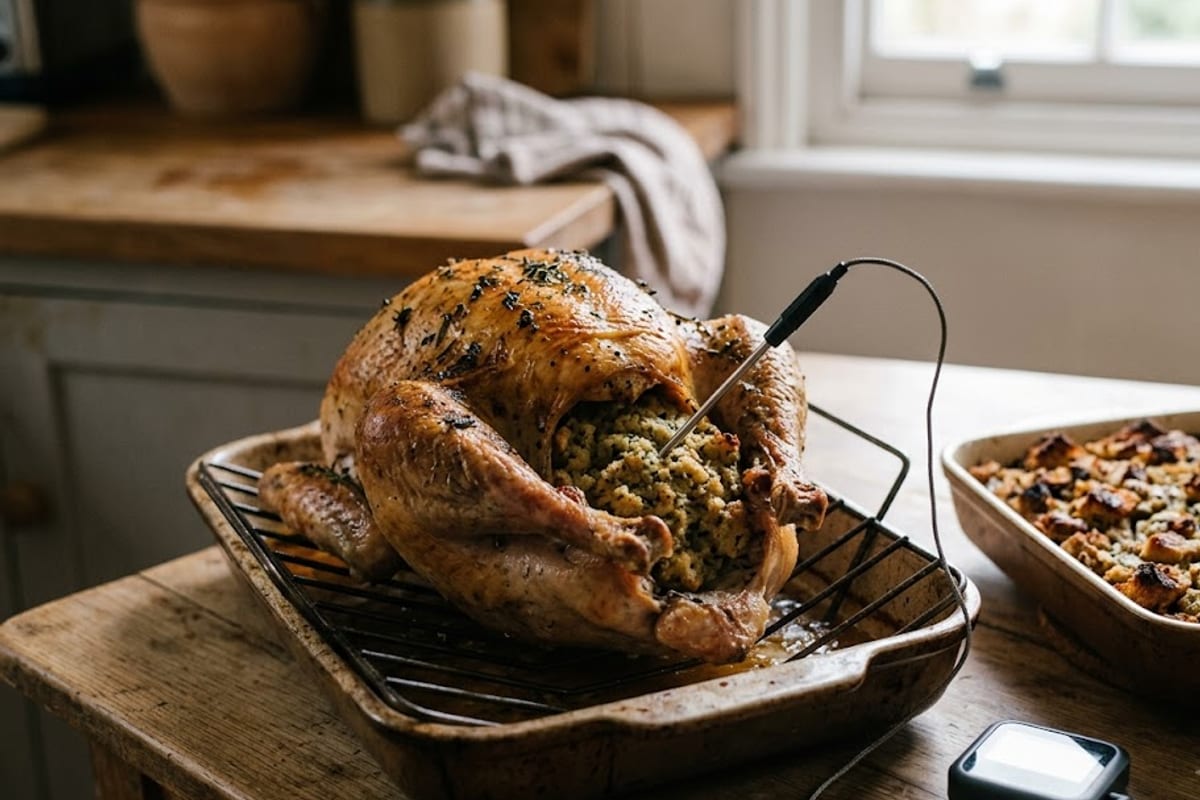
Stuffing has to reach 165°F itself, and it sits in the coldest part of the bird with meat insulating it on all sides.
By the time stuffing at the centre of a 16 lb turkey reaches 165, the breast is commonly at 180 and beyond saving. There is no oven temperature that fixes this — it is a geometry problem.
Cooking the stuffing in a separate dish removes it entirely, and it browns better besides. If it goes in the cavity, pack it loosely, take a third reading in the middle of it, and accept the trade.
Resting is not optional at this size
20 to 30 minutes, uncovered or loosely tented. A 16 lb bird holds enormous thermal mass and stays hot far longer than it feels like it should.
Carving immediately loses a visible amount of liquid onto the board. Twenty minutes lets the muscle fibres relax and reabsorb it, and the bird will still be too hot to handle comfortably when you start.
Thawing is the other thing that runs on a clock: 24 hours per 4 to 5 lb in the refrigerator. A 16 lb bird needs four days, and there is no fast alternative that does not compromise either safety or texture.
The same pull-versus-serve arithmetic applies to every other cut, just with more carryover here than anywhere else in the kitchen.