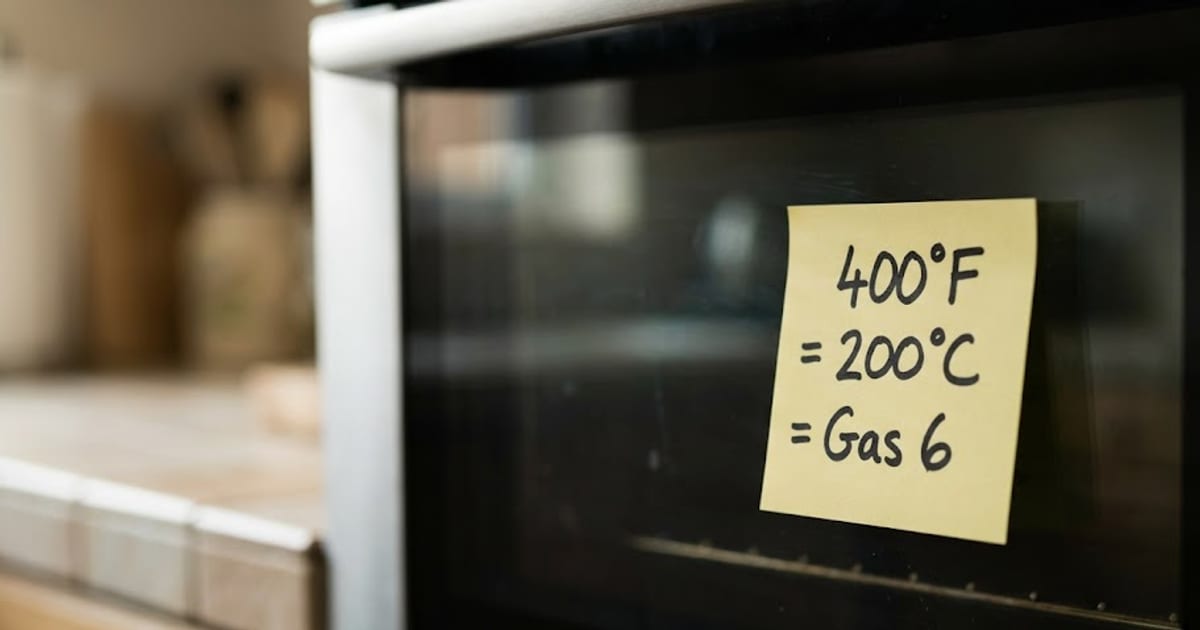
| Fahrenheit | Celsius | Fan / convection °C | Gas mark |
|---|---|---|---|
| 275°F | 140°C | 120°C | 1 |
| 300°F | 150°C | 130°C | 2 |
| 325°F | 160°C | 140°C | 3 |
| 350°F | 180°C | 160°C | 4 |
| 375°F | 190°C | 170°C | 5 |
| 400°F | 200°C | 180°C | 6 |
| 425°F | 220°C | 200°C | 7 |
| 450°F | 230°C | 210°C | 8 |
| 475°F | 240°C | 220°C | 9 |
The formula, and where the chart departs from it
°C = (°F − 32) × 5 ÷ 9
°F = °C × 9 ÷ 5 + 32
Run 350°F through it and you get 176.7°C, not 180. Run 400°F and you get 204.4°C, not 200.
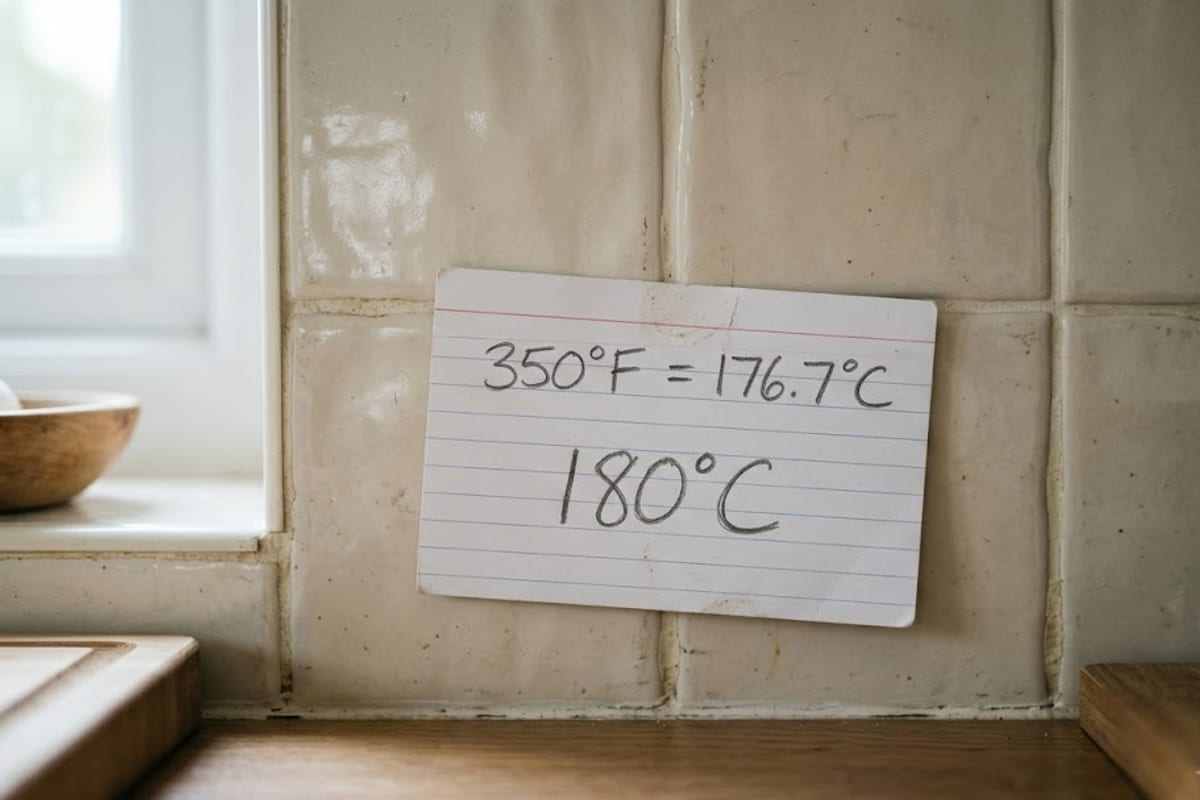
Every published chart rounds to the nearest convenient number, because oven dials are marked in steps and because a five-degree difference is smaller than the error in a domestic oven anyway. The rounding is not sloppiness; it is an admission that this precision does not exist in practice.
It does mean that converting back and forth twice will not return you to where you started. Convert once, from the original.
Fan ovens run 20°C lower
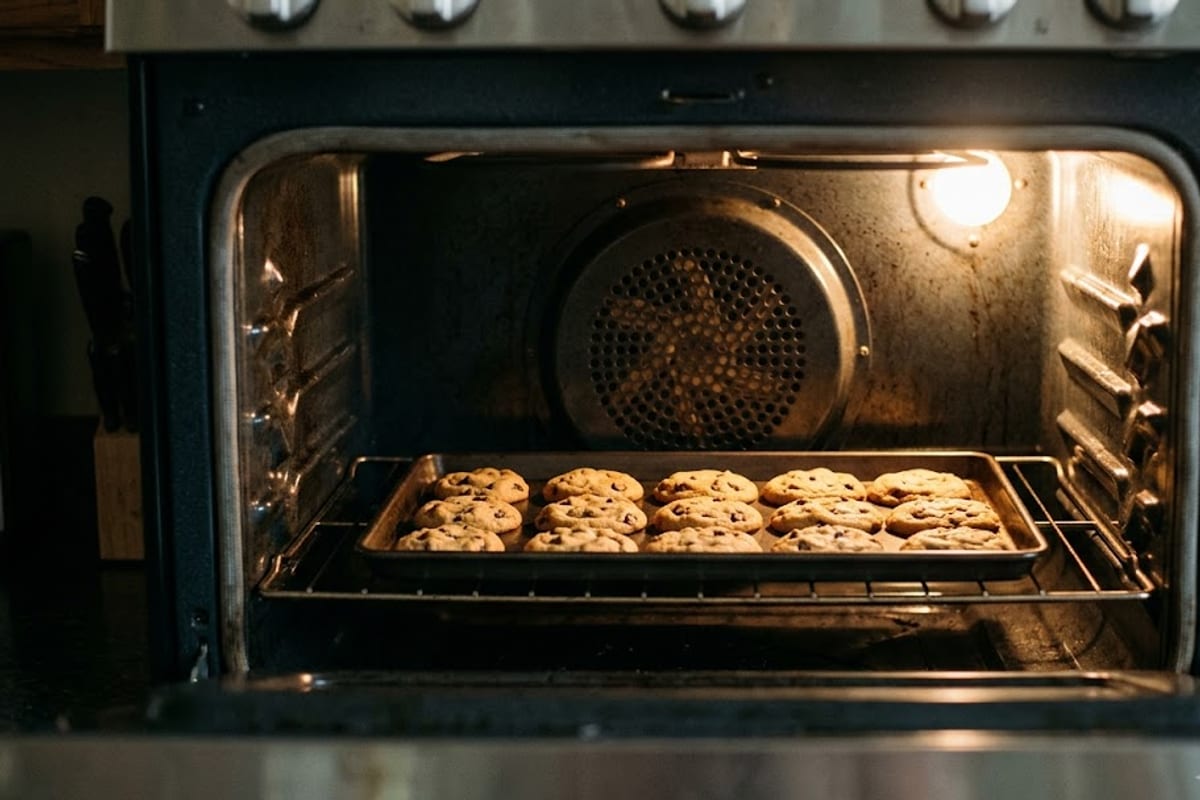
A fan-assisted or convection oven moves air across the food, which strips away the insulating layer of still air at the surface and transfers heat faster.
The standard adjustment is 20°C lower, or about 25 to 30°F, for the same result. Some manufacturers say 25°C; the difference between those two recommendations is smaller than the variation between two ovens.
Timing also shortens — roughly 10% less — though this varies more than the temperature adjustment does. Two practical consequences:
Recipes rarely say which they assume. British recipes usually give both, in the form "200°C / 180°C fan". American recipes usually assume a conventional oven and mention convection as an option.
A fan is worse for some things. Anything that needs to rise before it sets — soufflés, some cakes, delicate pastry — can be dried or lopsided by moving air. Most fan ovens can switch the fan off for exactly this reason.
Gas marks
The British gas mark scale is not linear at the bottom. Marks ¼ and ½ exist below mark 1, at 110°C and 130°C, and they are used for slow cooking and meringues.
From mark 1 upward each step is 25°F, or about 14°C, which makes the top of the scale regular even though the bottom is not.
Where in the oven, not just how hot
A conversion tells you the setpoint. It says nothing about where in the cavity that temperature actually exists, and in most domestic ovens it varies by 25 to 50°F between the top and the bottom.
Heat rises, so the top rack runs hotter in a conventional oven. The back is usually hotter than the door. A tray of cookies on one rack browns unevenly for that reason alone, which is why rotating the tray halfway through is standard advice rather than fussiness.
A fan evens this out considerably, and it is the main practical argument for convection on anything baked in quantity.
The middle rack is the default for a reason. Recipes that do not specify a rack position assume it, and moving up or down changes the result more than a 25°F adjustment to the dial would.
Preheating takes longer than the beep
Most ovens signal that they have reached temperature when the air sensor hits the setpoint. The walls, the racks and the stone or steel if you use one are still colder, and they carry most of the radiant heat that browns the outside of things.
Give it 10 to 15 minutes past the beep for ordinary baking, and considerably longer if there is a baking stone in there. Bread and pizza in particular fail in ways that look like a recipe problem when the real cause is a cavity that had not finished warming.
The number that matters more than any conversion
Your own oven's real temperature. Domestic ovens commonly run 15 to 25°F away from the dial, and they cycle on and off around a setpoint rather than holding it — the swing can be 25°F in either direction on an older oven.
An oven thermometer costs a few dollars and settles it permanently. It is worth more than any conversion table on this page, because a perfectly converted 180°C is useless in an oven that delivers 165.
Once you know the offset, every recipe on this site and everywhere else becomes more accurate at once. And the way temperature changes cooking time is a predictable relationship rather than a fixed number of minutes.