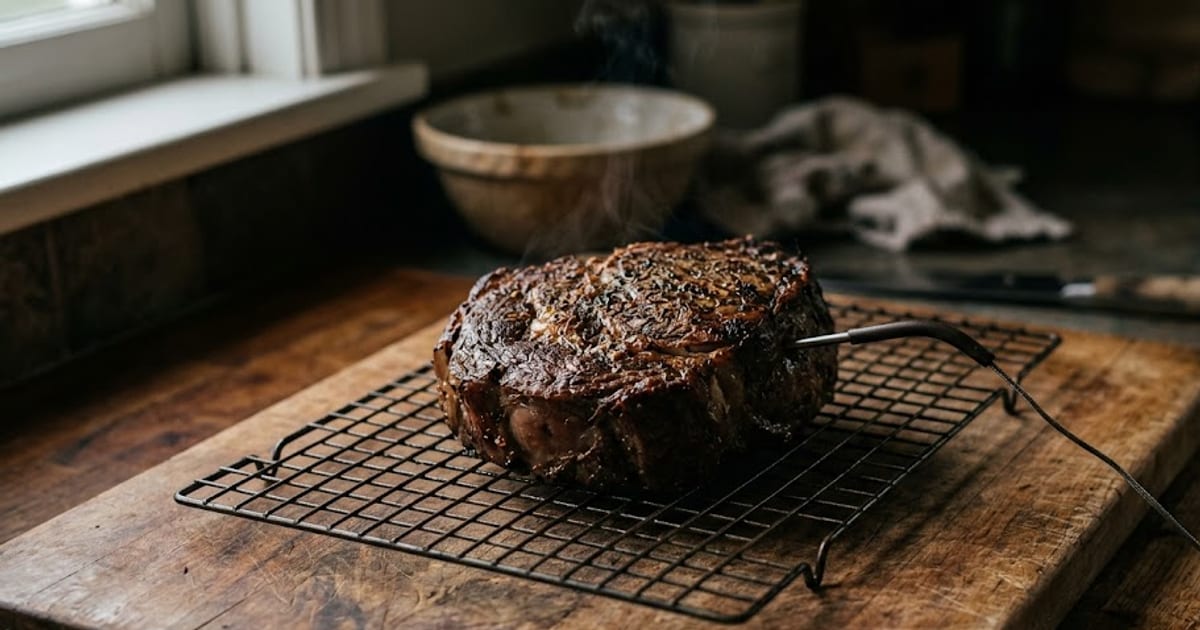
When meat comes off the heat, the outside is far hotter than the centre. That heat keeps moving inward until the temperature evens out, and the centre keeps climbing.
That rise is carryover cooking, and it is the difference between a roast that is what you wanted and one that is a stage past it.
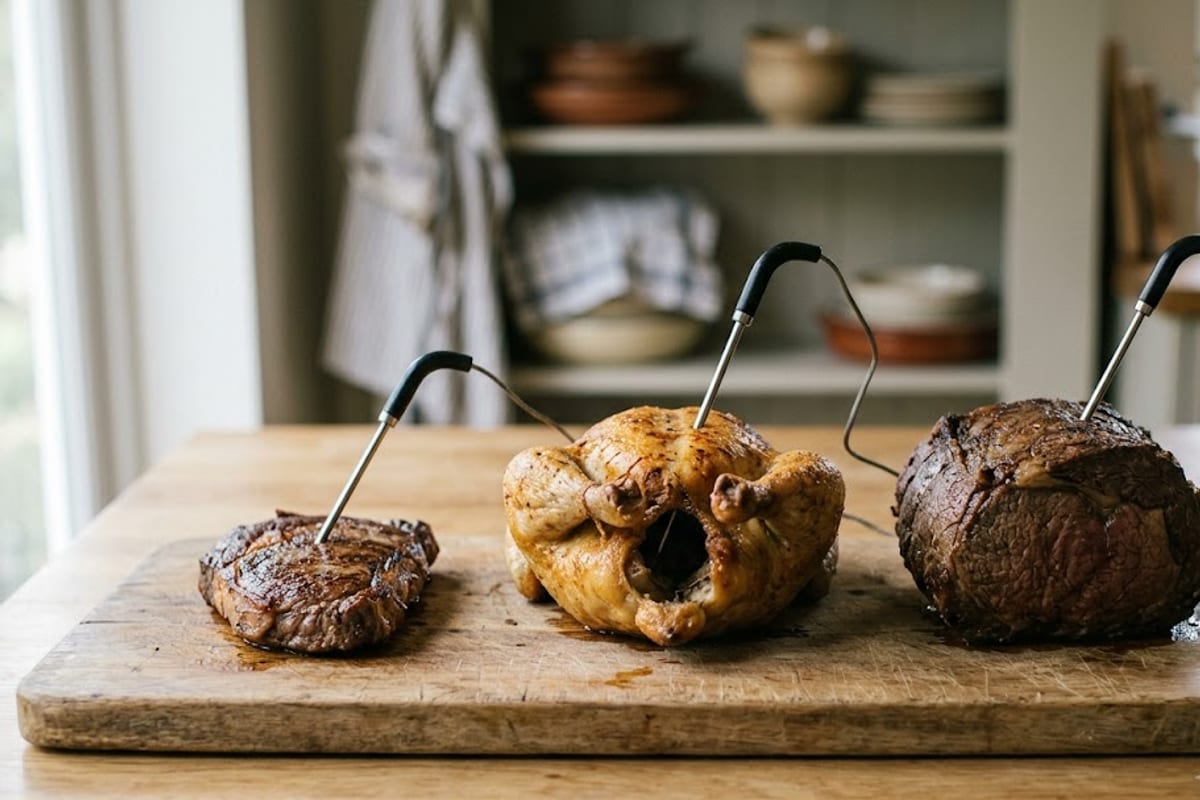
How much rise to expect
| Cut | Typical rise |
|---|---|
| Steak or chop, 1–1.5″ | 2–5°F |
| Chicken pieces | 3–5°F |
| Whole chicken | 5–8°F |
| Pork loin or beef roast, 3–5 lb | 5–10°F |
| Large roast or whole turkey | 10–15°F |
The pattern is that larger cuts carry over more, because there is more stored heat and further for it to travel.
What increases it
Higher cooking temperature. A roast seared at 475°F has a much hotter exterior than one cooked at 250°F, so it carries over more. Low-and-slow cooking produces very little carryover, which is one of its practical advantages.
Size and thickness, as above.
Resting covered. Foil traps heat and increases the rise. Tenting loosely is a compromise; wrapping tightly maximises it.
Density. A dense roast holds and moves heat differently from a loose, open cut.
Pull temperatures
Subtract the expected rise from the target:
Beef, medium rare — target 130–135°F, pull at about 125°F. Pork loin — target 145°F, pull at about 138°F. Whole chicken — target 165°F in the thigh, pull at about 158°F. Turkey — target 165°F, pull at about 155°F given the mass.
For food safety, the target is what matters and it must be reached — carryover counts toward it, which is precisely why pulling early works rather than being a shortcut.
Rest time
Steaks and chops — 5 to 10 minutes. Chicken pieces — 5 to 10 minutes. Whole chicken — 15 to 20 minutes. Large roasts and turkey — 20 to 40 minutes.
Resting does two things at once. Carryover finishes, and the muscle fibres relax and reabsorb juice that pressure had pushed toward the centre. Cutting immediately loses that juice onto the board.
A large roast holds serving temperature for a surprisingly long time — a turkey rested 40 minutes is still hot, and the panic about it going cold is misplaced.
Where it does not apply
Thin cuts cooked fast — a minute steak, a thin cutlet — have too little mass to carry over meaningfully.
Sous vide, where the whole piece is already at target temperature and there is no gradient to even out. A seared sous vide steak carries over slightly from the sear and no more.
Anything cooked well done, where a few degrees changes nothing.
Measuring properly
Carryover is only useful if the reading is accurate. Probe the thickest part, away from bone, and check more than one spot on a large cut.
An instant-read thermometer that is slow or badly calibrated makes all of this guesswork. Check it in ice water — it should read 32°F — before trusting it on an expensive roast.
Where to rest it
On a board or a warm plate, uncovered or loosely tented. A tight foil wrap traps steam against the crust and softens anything you spent effort browning, and it increases carryover beyond what you planned for.
For a roast with skin or crackling, rest uncovered in a warm place. The skin stays crisp and the carryover is closer to the lower end of the range, which is easy to allow for.
Do not rest meat on a cold plate. It draws heat out of the underside and produces an unevenly finished piece.
Practising the number
The rise is specific to your oven, your cuts and your habits, and the tables here are a starting point. Recording pull temperature and final temperature two or three times for a cut you cook often turns the general figure into your figure.
It takes no extra effort — the thermometer is already in your hand at both moments — and after three roasts the guesswork is gone.
The mistake that costs most
Leaving the probe in and watching the number climb, then panicking and slicing early to stop it. Slicing releases the juice that the rest was retaining, so the meat is both overcooked at the edges and drier than it needed to be.
Pull early, rest fully, and accept that the number will move. That is the whole technique.